Advertisements
Advertisements
Question
Tick the right answer.
When we come to terms with something, it is (still upsetting/no longer upsetting).
Advertisements
Solution
When we come to terms with something, it is no longer upsetting.
RELATED QUESTIONS
Answer these question in 30–40 words.
When and how did Bismillah Khan get his big break?
Answer these question in 30–40 words.
Why did Bismillah Khan refuse to start a shehnai school in the U.S.A.?
Answer the following question in one or two sentences.
In what ways did Kezia’s grandmother encourage her to get to know her father better?
Answer the question in a short paragraph.
What difference does the author note between the flute seller and the other hawkers?
How has Prashant, a teenager, been able to help the people of his village?
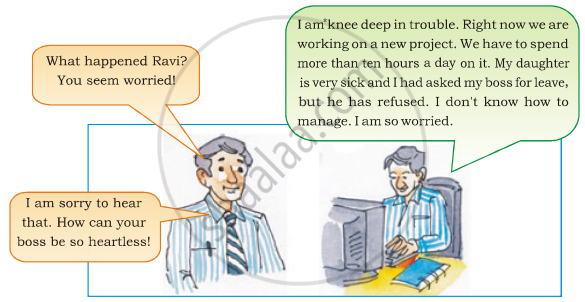
Read the following conversation between two friends.
The angel wrote and vanished.
The next night, It came again with a great wakening light,
And show's the names whom love of God had blest,
And Lo! Bin Adhem's name led all the rest.
Read the lines given above and answer the following question.
Explain with reference to context.
The horse was nearly life-size, moulded out of clay, baked, burnt, and brightly coloured, and reared its head proudly, prancing its forelegs in the air and flourishing its tail in a loop; beside the horse stood a warrior with scythelike mustachios, bulging eyes, and aquiline nose. The old image-makers believed in indicating a man of strength by bulging out his eyes and sharpening his moustache tips, and also decorated the man’s chest with beads which looked today like blobs of mud through the ravages of sun and wind and rain (when it came), but Muni would insist that he had known the beads to sparkle like the nine gems at one time in his life.
Read the extract given below and answer the question that follow.
Had anyone seen the splendour of the horse?
The village consisted of less than thirty houses, only one of them built with brick and cement. Painted a brilliant yellow and blue all over with gorgeous carvings of gods and gargoyles on its balustrade, it was known as the Big House. The other houses, distributed in four streets, were generally of bamboo thatch, straw, mud, and other unspecified material. Muni’s was the last house in the fourth street, beyond which stretched the fields. In his prosperous days Muni had owned a flock of forty sheep and goats and sallied forth every morning driving the flock to the highway a couple of miles away.
Read the extract given below and answer the question that follow.
What did Muni feed his flock with? When did he come back home? What did he carry home?
“So that is what you are doing out here? A marshal!” “My dear Miss Fairchild,” said ’ Easton, calmly, “I had to do something. Money has & way of taking wings unto itself, and
you know it takes money to keep step with our crowd in Washington. I saw this opening in the West, and—well, a marshalship isn’t quite as high a position as that of ambassador, but—” “The ambassador,” said the girl, warmly, “doesn’t call any more. He needn’t ever have done so. You ought to know that. And so now you are one of these dashing Western heroes, and you ride and shoot and go into all kinds of dangers. That’s different from the Washington life. You have been missed from the old crowd.” The girl’s eyes, fascinated, went back, widening a little, to rest upon the glittering handcuffs. “Don’t you worry about them, miss,” said the other man. “All marshals handcuff themselves to their prisoners to keep them from getting away. Mr. Easton knows his business.” “Will we see you again soon in Washington?” asked the girl. “Not soon, I think,” said Easton. “My butterfly days are over, I fear.”
Read the extract given below and answer the question that follow.
Easton says, “it takes money to keep step with our crowd in Washington.” What do you suppose he means by this?
At Denver there was an influx of passengers into the coaches on the eastbound B. & M. express. In one coach there sat a very pretty young woman dressed in elegant taste and surrounded by all the luxurious comforts of an experienced traveler. Among the newcomers were two young men, one of handsome presence with a bold, frank countenance and manner; the other a ruffled, glum-faced person, heavily built and roughly dressed. The two were handcuffed together.
As they passed down the aisle of the coach the only vacant seat offered was a reversed one facing the attractive young woman. Here the linked couple seated themselves. The young woman’s glance fell upon them with a distant, swift disinterest; then with a lovely smile brightening her countenance and a tender pink tingeing her rounded cheeks, she held out a little gray-gloved hand. When she spoke her voice, full, sweet, and deliberate, proclaimed that its owner was accustomed to speak and be heard.
“Well, Mr. Easton, if you will make me speak first, 1 suppose 1 must. Don’t vou ever recognize old friends when you meet them in the West?”
The younger man roused himself sharply at the sound of her voice, seemed to struggle with a slight embarrassment which he threw off instantly, and then clasped her fingers with his left hand.
He slightly raised his right hand, bound at the wrist by the shining “bracelet” to the left one of his companion.
Read the extract given below and answer the question that follow.
What is strange about the way the two men are travelling? Why do you suppose they are like this?
Joe did not see the Guardians of the Poor on that day, on the next, nor on the day following. In fact, he never saw them at all on Maggie’s account, for in less than a week Mrs. Joe Thompson would as soon leave thought of taking up her own abode in the almshouse as sending Maggie there.
What light and blessing did that sick and helpless child bring to the home of Joe Thompson, the poor wheelwright! It had been dark, and cold, and miserable there for a long time just because his wife had nothing to love and care for out of herself, and so became soar, irritable, ill-tempered, and self-afflicting in the desolation of her woman’s nature. Now the sweetness of that sick child, looking ever to her in love, patience, and gratitude, was as honey to her soul, and she carried her in her heart as well as in her arms, a precious burden. As for Joe Thompson, there was not a man in all the neighbourhood who drank daily of a more precious wine of life than he. An angel had come into his house, disguised as a sick, helpless, and miserable child, and filled all its dreary chambers with the sunshine of love.
Read the extract given below and answer the question that follow.
Why did Joe not see the Guardians of the poor on that day or ever again?
Mark the right item.
The greedy couple borrowed the mill and the mortar to make
Multiple Choice Question:
What does the word ‘soars’ in the above extract mean?
Answer the following question.
Why do you think the writer visited Miss Beam’s school?
Answer the question.
Why does the poet want to know where the teachers go at four o’clock?
What decisions were given by Algu and Jumman as head Panch?
Can there be a good reason behind staying silent when everybody is talking?
Why does the rebel demand for the rain when everybody is praising the sun?
What else do you think Nishad and Maya will find out about him? How? Will they ever be friends? Think about these questions and write a paragraph or two to continue the story.
