Advertisements
Advertisements
Question
Thinking about the poem
Where does the traveller find himself? What problem does he face?
Advertisements
Solution
The traveller finds himself in the yellow woods at a point where the road forks into two. The problem that he faces is that he cannot decide which road to take to continue his journey since it is not possible for him to travel both roads at the same time.
RELATED QUESTIONS
Explain what the reason for the following is .
Einstein wanting to study in Switzerland rather than in Munich.
Bangle sellers are we who bear
Our shining loads to the temple fair...
Who will buy these delicate, bright
Rainbow-tinted circles of light?
Lustrous tokens of radiant lives,
For happy daughters and happy wives.
Read the lines given above and answer the question that follow.
Explain with reference to context.
The waves beside them danced, but they
Out-did the sparkling leaves in glee;
A poet could not be but gay,
In such a jocund company!
I gazed-and gazed-but little thought
What wealth the show to me had brought:
Read the lines given above and answer the question that follow.
Which jocund company is the poet referring to ?
It was my business to cross the bridge, explore the bridge head 3 beyond and find out to what point the enemy had advanced. I did this and returned over the bridge. There were not so many carts now and very few people on foot, but the old man was still there.’’Where do you come from?” I asked him.
“From San Carlos,” he said, and smiled.
That was his native town and so it gave him pleasure to mention it and he smiled.
“I was taking care of animals,” he explained.
“Oh,” I said, not quite understanding.
“Yes,” he said, “I stayed, you see, taking care of animals. I was the last one to leave the town of San Carlos.”
He did not look like a shepherd nor a herdsman and I looked at his black dusty clothes and his gray dusty face and his steel rimmed spectacles and said, “What animals were they?”
“Various animals,” he said, and shook his head. “I had to leave them.”
Read the extract given below and answer the question that follow.
What did the narrator see on the bridge when he returned?
She lighted another match, and then she found herself sitting under a beautiful Christmas-tree. It was larger and more beautifully decorated than the one which she had seen through the glass door at the rich merchant’s. Thousands of tapers were burning upon the green branches, and colored pictures, like those she had seen in the show- windows, looked down upon it all. The little one stretched out her hand towards them, and the match went out.
The Christmas lights rose higher and higher, till they looked to her like the stars in the sky. Then she saw a star fall, leaving behind it a bright streak of fire. “Someone is dying,” thought the little girl, for her old grandmother, the only one who had ever loved her, and who was now dead, had told her that when a star falls, a soul was going up to God.
Read the extract given below and answer the question that follow.
What happened when she stretched her hand to touch?
Margot stood apart from these children who could never remember a time when there wasn’t rain and rain and rain. They were all nine years old, and if there had been a day, seven years ago, when the sun came out for an hour and showed its face to the stunned world, they could not recall. Sometimes, at night, she heard them stir, in remembrance, and she knew they were dreaming and remembering an old or a yellow crayon or a coin large enough to buy the world with. She knew they thought they remembered a warmness, like a blushing in the face, in the body, in the arms and legs and trembling hands. But then they always awoke to the tatting drum, the endless shaking down of clear bead necklaces upon the roof, the walk, the gardens, the forests, and their dreams were gone. All day yesterday they had read in class about the sun. About how like a lemon it was, and how hot. And they had written small stories or essays or poems about it:
I think the snn is a flower,
That blooms for just one hour.
Read the extract given below and answer the question that follow.
What memory disturbed the children at night sometimes?
Margot stood apart from these children who could never remember a time when there wasn’t rain and rain and rain. They were all nine years old, and if there had been a day, seven years ago, when the sun came out for an hour and showed its face to the stunned world, they could not recall. Sometimes, at night, she heard them stir, in remembrance, and she knew they were dreaming and remembering an old or a yellow crayon or a coin large enough to buy the world with. She knew they thought they remembered a warmness, like a blushing in the face, in the body, in the arms and legs and trembling hands. But then they always awoke to the tatting drum, the endless shaking down of clear bead necklaces upon the roof, the walk, the gardens, the forests, and their dreams were gone. All day yesterday they had read in class about the sun. About how like a lemon it was, and how hot. And they had written small stories or essays or poems about it:
I think the snn is a flower,
That blooms for just one hour.
Read the extract given below and answer the question that follow.
What had Margot written about the sun in her poem?
Who is Canynge? What scandal is being referred to? Why will it be a scandal?
Answer the following question.
Who helped Golu on the bank of the river?
Discuss the following topic in groups
Most people keep dogs and cats as pets. Can you think of some unusual pets that people keep?
The king rewarded the shepherd twice. How and why?
Who made the pact with the Sun and why? How did the pact prove fruitful?
A snake has no legs or feet, but it moves very fast. Can you guess how? Discuss in the group.
What does the writer say about the friendship between man and dog?
Answer the following question:
How did she become an astronaut? What gave her the idea that she could be an astronaut?
Look at the following picture. One asks a question, the other answers it. Then the answer is noted in a form as shown below.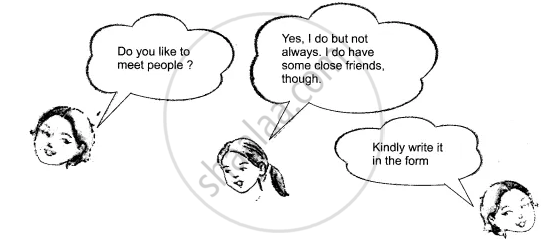
| Questions | Yes/No | Additional Response |
|
1. Do you like to meet people? |
Yes I do, but not always | I do have some close friends, though. |
|
2. Do you like the area you live in? |
No, I Don't | But I have no choice |
Why does the rebel demand for the rain when everybody is praising the sun?
What did the dog do to lead the farmer to the hidden gold?
The words helper, companion, partner and accomplice have very similar meanings, but each word is typically used in certain phrases. Can you fill in the blanks below with the most commonly used words? A dictionary may help you.
the thief’s ……………
| Caliban: |
No noise, and enter |
In the above lines taken from Act IV Scene i of the play, The Tempest, what does Caliban refer to by the phrase “good mischief“?
