Advertisements
Advertisements
प्रश्न
Thinking about the poem
Where does the traveller find himself? What problem does he face?
Advertisements
उत्तर
The traveller finds himself in the yellow woods at a point where the road forks into two. The problem that he faces is that he cannot decide which road to take to continue his journey since it is not possible for him to travel both roads at the same time.
संबंधित प्रश्न
Tick the right answer.
When we come to terms with something, it is (still upsetting/no longer upsetting).
Answer the following question in one or two sentences.
Why was Kezia afraid of her father?
Simple Present Tense
In these sentences words like everyday, often, seldom, never, every
month, generally, usually, etc. may be used.
Fill in the blanks with the correct form of the verb in brackets.
The African lungfish can live without water for up to four years. During drought, it
___(dig) a pit and ___(enclose) itself in a capsule of slime and earth, leaving a tiny opening
for air. The capsule ___(dry) and ___(harden), but when rain ___(come), the mud
___(dissolve) and the lungfish ___(swim) away.
Thinking about the Poem
“…whenever we are told to hate our brothers…” When do you think this happens?
Why? Who ‘tells’ us? Should we do as we are told at such times? What does the poet say?
Answer the following question in one or two sentences.
Had Abdul Kalam earned any money before that? In what way?
Based on your reading of the story, answer the following question by choosing the correct options.
One could hammer nails into Corporal Turnbull without his noticing it because ____
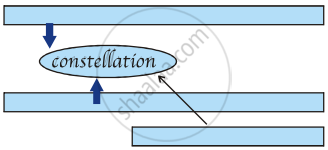
Read the following extracts from the story, and try to puzzle out the meanings of the encircled words from other words and phrases in the extract. Write the clues in the empty boxes. Then give your own explanation of the encircled words.
I saw individual stars, but I could not distinguish the constellation they belonged to. Then dawn came and put out all my stars.
Therefore, constellation means ______.
Such wondrous, fine, fantastic tales
Of dragons, gypsies, queens, and whales
And treasure isles, and distant shores
Where smugglers rowed with muffled oars,
And pirates wearing purple pants,
And sailing ships and elephants,
And cannibals crouching 'round the pot,
Stirring away at something hot.
(It smells so good , what can it be?
Good gracious, it's Penelope.)
The younger ones had Beatrix Potter
With Mr.Tod,the dirty rotter,
And Squirrel Nutkin,Pigling Bland,
And Mrs.Tiggy-Winkle and-
Just How The Camel Got His Hump,
And How the Monkey Lost His Rump,
And Mr. Toad, and bless my soul,
There's Mr.Rat and Mr. Mole-
Oh, books, what books they used to know,
Those children living long ago!
Read the lines given above and answer the question given below.
Which animal characters does Dahl mention?’
I wandered lonely as a Cloud
That floats on high o'er vales and Hills,
When all at once I saw a crowd,
A host, of golden Daffodils;
Beside the Lake, beneath the trees,
Fluttering and dancing in the breeze.
Read the lines given above and answer the question that follow.
Who wandered like a lonely cloud and where ?
I wandered lonely as a Cloud
That floats on high o'er vales and Hills,
When all at once I saw a crowd,
A host, of golden Daffodils;
Beside the Lake, beneath the trees,
Fluttering and dancing in the breeze.
Read the lines given above and answer the question that follow.
Who does he come across while wandering ?
The angel wrote and vanished.
The next night, It came again with a great wakening light,
And show's the names whom love of God had blest,
And Lo! Bin Adhem's name led all the rest.
Read the lines given above and answer the following question.
Mention two other words used by the poet to refer to the angel.
The blocks were all lined up for those who would use them
The hundred-yard dash and the race to be run
These were nine resolved athletes in back of the starting line
Poised for the sound of the gun.
The signal was given, the pistol exploded
And so did the runners all charging ahead
But the smallest among them,he stumbled and staggered
And fell to the asphalt instead.
He gave out a cry in frustration and anguish
His dreams ands his efforts all dashed in the dirt
But as sure I'm standing here telling this story
The same goes for what next occurred.
Read the lines given above and answer the following question:
The word ‘exploded’ is used for the firing of the pistol. What does the phrase ‘so did the runners’ in line 2 of stanza 4 mean?
“So that is what you are doing out here? A marshal!” “My dear Miss Fairchild,” said ’ Easton, calmly, “I had to do something. Money has & way of taking wings unto itself, and
you know it takes money to keep step with our crowd in Washington. I saw this opening in the West, and—well, a marshalship isn’t quite as high a position as that of ambassador, but—” “The ambassador,” said the girl, warmly, “doesn’t call any more. He needn’t ever have done so. You ought to know that. And so now you are one of these dashing Western heroes, and you ride and shoot and go into all kinds of dangers. That’s different from the Washington life. You have been missed from the old crowd.” The girl’s eyes, fascinated, went back, widening a little, to rest upon the glittering handcuffs. “Don’t you worry about them, miss,” said the other man. “All marshals handcuff themselves to their prisoners to keep them from getting away. Mr. Easton knows his business.” “Will we see you again soon in Washington?” asked the girl. “Not soon, I think,” said Easton. “My butterfly days are over, I fear.”
Read the extract given below and answer the question that follow.
What reason does Easton give for not keeping up with their crowd in Wahington?
Why the early man was afraid of fire?
What assurance did the sunrays give to Saeeda?
Give two example of trees that have a number of uses in everybody’s life.
Do you agree with what the poet says? Talk to your partner and complete these sentences.
(i) A house is made of ____________.
(ii) It has ____________.
(iii) A home is made by ____________.
(iv) It has ____________.
Multiple Choice Question:
When does the kite lose all its energy?
What is being compared to a gray overcoat?
