Advertisements
Advertisements
Question
There are two isomers with the formula CH3NO2. How will you distinguish between them?
Advertisements
Solution
CH3NO2 has two isomers.
They are
1. CH3 – NO2 (Nitromethane)
2. \[\begin{array}{cc}
\ce{CH2 = NOH}\\
\phantom{...}↓\\
\phantom{....}\ce{O}
\end{array}\]
\[\begin{array}{cc}
\phantom{}\ce{H}\phantom{...}\ce{O}\phantom{..............................}\\
\phantom{}|\phantom{....}||\phantom{..............................}\\
\ce{OH - C - N -> O <->[Tautomerises] CH2 = N - O - H}\\
\phantom{.}|\phantom{..............................}↓\phantom{...}\\
\phantom{.}\ce{\underset{(Nitro-form)}{H}}\phantom{.......................}\ce{\underset{(Aci-form)}{O}}\phantom{....}
\end{array}\]
| Sr. No. | Nitro methane (Nitro-form) |
Methyl nitrite (Aci-form) |
| (i) | Less acidic in nature. | More acidic and also called pseudoacids (or) nitronic acids. |
| (ii) | Dissolves in NaOH slowly. | Dissolves in NaOH instantly. |
| (iii) | Decolourises FeCl3 solution. | FeCl3 gives reddish brown colour. |
| (iv) | Electrical conductivity is low. | Electrical conductivity is high. |
APPEARS IN
RELATED QUESTIONS
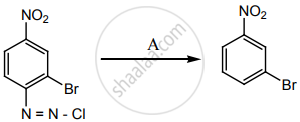
‘A’ is:
C5H13N reacts with HNO2 to give an optically active compound – The compound is ____________.
Secondary nitro alkanes react with nitrous acid to form ____________.
Among the following, the reaction that proceeds through an electrophilic substitution is:
What happens when 2-Nitropropane boiled with HCl?
Write a short note on the following.
Hofmann’s bromide reaction
Identify A, B and C.

Account for the following.
Aniline does not undergo Friedel–Crafts reaction.
Account for the following:
Aniline does not undergo Friedel - Crafts reaction.
Account for the following:
Aniline does not undergo Friedel – Crafts reaction.
