Advertisements
Advertisements
Question
The work done by a force acting obliquely is given by the formula : W = F cos θ ✕ s. What will happen to the work done if angle θ between the direction of force and motion of the body is increased gradually? Will it increase, decrease or remain constant.
Advertisements
Solution
The relation between work, force, distance and angle between the two is:
W = (F) (S) cos θ
Where,
(W) - Work done
(F) - Force
(S) - Displacement
(θ) - Angle between force and displacement
Let us see the graph of to understand the dependence of work on the angle between force and distance.
From the graph, we can observe that on increasing the value of angle between force and distance, value of cos θ continuously decreases and becomes negative after `pi/2`.
Hence, if we increase the angle between force and distance gradually, the value of work done will continuously decrease.
APPEARS IN
RELATED QUESTIONS
A pair of bullocks exerts a force of 140 N on a plough. The field being ploughed is 15 m long. How much work is done in ploughing the length of the field?
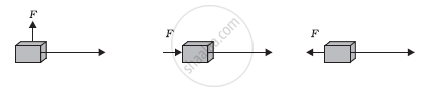
In each of the following a force, F is acting on an object of mass, m. The direction of displacement is from west to east, as shown by the longer arrow. Observe the diagrams carefully and state whether the work done by the force is negative, positive or zero.
A coolie is moving on a road with a luggage on his head. Does he perform work against the force of gravity? Give reason for your answer.
Write the formula for the work done on a body when a force acts on the body in the direction of its displacement. Give the meaning of each symbol which occurs in the formula.
What should be the angle between the direction of force and the direction of motion of a body so that the work done is zero?
How much work is done by the gravitational force of earth acting on a satellite moving around it in a circular path? Give reason for your answer.
A coolie is pushing a box weighing 1500 N up an inclined plane 7.5 m long on to a platform, 2.5 m above the ground.
(i) Calculate the mechanical advantage of the inclined plane. (ii) Calculate the effort applied by the coolie.
(iii) In actual practice, the coolie needs to apply more effort than what is calculated. Give one reason why you think the coolie needs to apply more effort.
