Advertisements
Advertisements
Question
Ravi applied a force of 10 N and moved a book 30 cm in the direction of the force. How much was the work done by Ravi?
Advertisements
Solution
Given:
Force (F) = 10 N,
Displacement (s) = 30 cm
= 30 × 10−2 m
Find: Work done (W) = ?
Formula: W = F × s
Calculations:
W = 10 × 30 × 10−2
W = `(10 xx 30)/100`
W = 3 J
Work done by Ravi is 3 J.
APPEARS IN
RELATED QUESTIONS
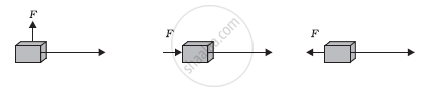
In each of the following a force, F is acting on an object of mass, m. The direction of displacement is from west to east, as shown by the longer arrow. Observe the diagrams carefully and state whether the work done by the force is negative, positive or zero.
A box of weight 150 kgf has gravitational potential energy stored in it equal to 14700 J. Find the height of the box above the ground. (Take g = 9.8 N kg-1)
The work done on an object does not depend on ______.
Why does a spanner have a long handle?
P, Q and R are three forces which act as shown in fig.
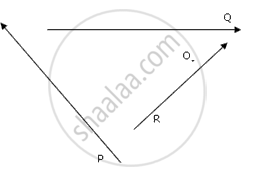
The point O lies in the same plane. Given, P = Q = R = 10N
(i) Which force has the least moment about O? Give a reason.
(ii)Which force has the greatest moment about O? Give a reason.
Nm is the unit of .......
Is power a scalar quantity?
Name the type of energy possessed by a
(i) stretched catapult (ii) hot iron
(iii) wound up clock
Name the CGS unit of work.
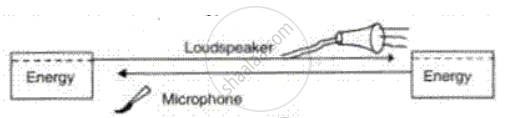
Fill in the boxe to show the corresponding energy transformation.
A man climbs a slope and another walks same distance on level road. Which of the two expends more energy and why?
Name two places in India where electricity is generated from nuclear power plants.
Calculate the work done when:
A 5 kg weight is lifted 10 m vertically. (g = 9.8 m/s2)
An electric motor pump is 60% efficient and is rated 2.5 H.P. Calculate the maximum load it can lift through a height of 10m in 8 sec. (1 H.P. = 750 W).
