Advertisements
Advertisements
प्रश्न
Ravi applied a force of 10 N and moved a book 30 cm in the direction of the force. How much was the work done by Ravi?
Advertisements
उत्तर
Given:
Force (F) = 10 N,
Displacement (s) = 30 cm
= 30 × 10−2 m
Find: Work done (W) = ?
Formula: W = F × s
Calculations:
W = 10 × 30 × 10−2
W = `(10 xx 30)/100`
W = 3 J
Work done by Ravi is 3 J.
APPEARS IN
संबंधित प्रश्न
Look at the activity below. Reason out whether or not work is done in the light of your understanding of the term ‘work’.
A sailboat is moving due to wind energy.
The S.I. unit of work is
A car is running at a speed of 15 km h-1 while another similar car is moving at a speed of 45 km h-1. Find the ratio of their kinetic energies.
Is work a scalar or a vector quantity?
Write an expression for the work done against gravity.
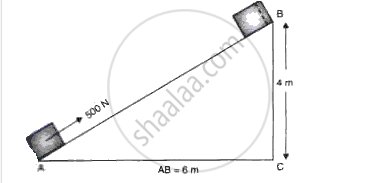
A block of mass 20 kg is pulled up a slope (fig.12) with a constant speed by applying a force of 500 N parallel to the slope. A and B are initial and final positions of the block.
(a) Calculate the work done by the force in moving the block from A and B.
(b) Calculate the potential energy gained by the block.
State the energy changes which take place when An electric bulb glows when it is connected to a source of electric current.
In the following case write yes, if the work is being done and no if no work is being done.
A coolie standing with a heavy load on his head
Is power a scalar or a vector quantity?
(i) A 200g ball is thrown vertically upward with an initial velocity of 30 ms-1. Draw a velocity-time graph for the motion of ball.
(ii) How long will the ball take to reach the highest point?
(iii) What will be the kinetic energy of ball, when it returns to the starting point, neglecting the air resistance?
(iv) What will be the potential energy of ball at highest point?
A girl of mass 40 kg runs a height of 80 stairs, each 25 cm high with a load of 20 kg on her head in 25 sec. If g is 10 m/s2, find:
(i) Gravitational force acting on the girl.
(ii) Work done by her.
(iii) Useful work done by her.
(iv) Her power in watt.
Look at the activity below. Reason out whether or not work is done in the light of your understanding of the term ‘work’.
A donkey is carrying a load on its back.
