Advertisements
Advertisements
Question
A boy of mass 40 kg climbs up the stairs and reaches the roof at a height 8 m in 5 s. Calculate:
- the force of gravity acting on the boy,
- the work done by him against the force of gravity,
- the power spent by boy. (Take g = 10 m s-2)
Advertisements
Solution
Mass of boy = 40 kg, Vertical height moved, h = 8 m, Time taken, t = 5s.
(i) Force of gravity on the boy F = mg
= 40 kg × 10 m/s-2
= 400 N
(ii) Work done against gravity, W = mgh
= 400 × 8
= 3200 J
(iii) Power = `"work"/"Time" = "mgh"/"t"`
`= (3200 " J")/(5 " s")`
= 640 W
APPEARS IN
RELATED QUESTIONS
Soni says that the acceleration in an object could be zero even when several forces are acting on it. Do you agree with her? Why?
A body of mass 5 kg falls from a height of 10 m to 4 m. Calculate:
The loss in potential energy of the body,
Complete the following sentences:
The SI unit of work is ....... and of power is .......
A woman pulls a bucket of water of total mass 5 kg from a well which is 10 s. calculate the power used by her.
Calculate the amount of work done by a child carrying a bag of 20 kg when he moves a distance of 40 m in
(a) Vertical direction, and
(b) Horizontal direction
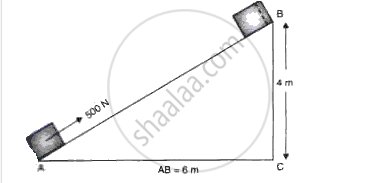
A block of mass 20 kg is pulled up a slope (fig.12) with a constant speed by applying a force of 500 N parallel to the slope. A and B are initial and final positions of the block.
(a) Calculate the work done by the force in moving the block from A and B.
(b) Calculate the potential energy gained by the block.
One labourer carried four pans of road metal through a distance of 100 metres. If he carries two pans of road metal through a 200 metre distance ______ work will be done.
A man squatting on the ground gets straight up and stand. The force of reaction of ground on the man during the process is ______.
