English
Karnataka Board PUCPUC Science 2nd PUC Class 12

The variation of decay rate of two radioactive samples A and B with time is shown in figure. Which of the following statements are true? - Physics

Advertisements
Advertisements

Question

The variation of decay rate of two radioactive samples A and B with time is shown in figure.
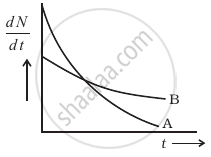
Which of the following statements are true?

  1. Decay constant of A is greater than that of B, hence A always decays faster than B.
  2. Decay constant of B is greater than that of A but its decay rate is always smaller than that of A.
  3. Decay constant of A is greater than that of B but it does not always decay faster than B.
  4. Decay constant of B is smaller than that of A but still its decay rate becomes equal to that of A at a later instant.

Options

  • a and b

  • a and c

  • b and d

  • c and d

MCQ
Advertisements

Solution

c and d

Explanation:

It can be observed from the figure that the slope of curve A is greater than that of curve B, it means the rate of decay is faster for A than that of B.

According to Rutherford and Soddy's law for radioactive decay `-((dN)/(dt)) ∝ λ`, where decay. Hence at point P, the rate of decay for both A and B is the same.

shaalaa.com
  Is there an error in this question or solution?
Chapter 13: Nuclei - Exercises [Page 83]

APPEARS IN

NCERT Exemplar Physics [English] Class 12
Chapter 13 Nuclei
Exercises | Q 13.10 | Page 83

Video TutorialsVIEW ALL [1]

RELATED QUESTIONS


(a) Write the basic nuclear process involved in the emission of β+ in a symbolic form, by a radioactive nucleus.

(b) In the reactions given below:

(i)`""_16^11C->_y^zB+x+v`

(ii)`""_6^12C+_6^12C->_a^20 Ne + _b^c He`

Find the values of x, y, and z and a, b and c.


Derive the mathematical expression for law of radioactive decay for a sample of a radioactive nucleus


Why is it found experimentally difficult to detect neutrinos in nuclear β-decay?


The normal activity of living carbon-containing matter is found to be about 15 decays per minute for every gram of carbon. This activity arises from the small proportion of radioactive `""_6^14"C"` present with the stable carbon isotope `""_6^12"C"`. When the organism is dead, its interaction with the atmosphere (which maintains the above equilibrium activity) ceases and its activity begins to drop. From the known half-life (5730 years) of `""_6^14"C"` and the measured activity, the age of the specimen can be approximately estimated. This is the principle of `""_6^14"C"` dating used in archaeology. Suppose a specimen from Mohenjodaro gives an activity of 9 decays per minute per gram of carbon. Estimate the approximate age of the Indus-Valley civilisation.


Represent Radioactive Decay curve using relation `N = N_o e^(-lambdat)` graphically


Define 'activity' of a radioactive substance ?


Two different radioactive elements with half lives T1 and T2 have N1 and N2 undecayed atoms respectively present at a given instant. Derive an expression for the ratio of their activities at this instant in terms of N1 and N2 ?


Why is it experimentally found difficult to detect neutrinos in this process ?


Define the activity of a given radioactive substance. Write its S.I. unit.


Calculate the maximum kinetic energy of the beta particle emitted in the following decay scheme:
12N → 12C* + e+ + v
12C* → 12C + γ (4.43MeV).
The atomic mass of 12N is 12.018613 u.

(Use Mass of proton mp = 1.007276 u, Mass of `""_1^1"H"` atom = 1.007825 u, Mass of neutron mn = 1.008665 u, Mass of electron = 0.0005486 u ≈ 511 keV/c2,1 u = 931 MeV/c2.)


The decay constant of `""_80^197`Hg (electron capture to `""_79^197`Au) is 1.8 × 10⁻⁴ S−1. (a) What is the half-life? (b) What is the average-life? (c) How much time will it take to convert 25% of this isotope of mercury into gold?


A source contains two species of phosphorous nuclei, \[\ce{_15^32P}\] (T1/2 = 14.3 d) and \[\ce{_15^33P}\] (T1/2 = 25.3 d). At time t = 0, 90% of the decays are from \[\ce{_15^32P}\]. How much time has to elapse for only 15% of the decays to be from \[\ce{_15^32P}\]?


Obtain an expression for the decay law of radioactivity. Hence show that the activity A(t) =λNO e-λt.  


Two radioactive materials X1 and X2 have decay constants 10λ and λ respectively. If initially, they have the same number of nuclei, then the ratio of the number of nuclei of X1 to that of X2 will belie after a time.


After 1 hour, `(1/8)^"th"` of the initial mass of a certain radioactive isotope remains undecayed. The half-life of the isotopes is ______.


When a nucleus in an atom undergoes a radioactive decay, the electronic energy levels of the atom ______.


Sometimes a radioactive nucleus decays into a nucleus which itself is radioactive. An example is :

\[\ce{^38Sulphur ->[half-life][= 2.48h] ^{38}Cl ->[half-life][= 0.62h] ^38Air (stable)}\]

Assume that we start with 1000 38S nuclei at time t = 0. The number of 38Cl is of count zero at t = 0 and will again be zero at t = ∞ . At what value of t, would the number of counts be a maximum?


The radioactivity of an old sample of whisky due to tritium (half-life 12.5 years) was found to be only about 4% of that measured in a recently purchased bottle marked 10 years old. The age of a sample is ______ years.


For the following reaction, the particle 'x' is 6C115B11 + β + X ______.


Two radioactive materials A and B have decay constants \[6\lambda\] and \[2\lambda\] respectively. If initially they have same number of nuclei, then the ratio of the number of nuclei of A to that of B will be \[\frac{1}{\mathrm{e}}\] after time ______.


Share
Notifications

Englishहिंदीमराठी


      Forgot password?
Use app×