मराठी
कर्नाटक बोर्ड पी.यू.सी.पीयूसी विज्ञान 2nd PUC Class 12

The variation of decay rate of two radioactive samples A and B with time is shown in figure. Which of the following statements are true? - Physics

Advertisements
Advertisements

प्रश्न

The variation of decay rate of two radioactive samples A and B with time is shown in figure.
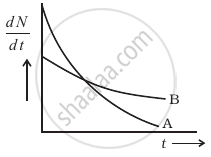
Which of the following statements are true?

  1. Decay constant of A is greater than that of B, hence A always decays faster than B.
  2. Decay constant of B is greater than that of A but its decay rate is always smaller than that of A.
  3. Decay constant of A is greater than that of B but it does not always decay faster than B.
  4. Decay constant of B is smaller than that of A but still its decay rate becomes equal to that of A at a later instant.

पर्याय

  • a and b

  • a and c

  • b and d

  • c and d

MCQ
Advertisements

उत्तर

c and d

Explanation:

It can be observed from the figure that the slope of curve A is greater than that of curve B, it means the rate of decay is faster for A than that of B.

According to Rutherford and Soddy's law for radioactive decay `-((dN)/(dt)) ∝ λ`, where decay. Hence at point P, the rate of decay for both A and B is the same.

shaalaa.com
  या प्रश्नात किंवा उत्तरात काही त्रुटी आहे का?
पाठ 13: Nuclei - Exercises [पृष्ठ ८३]

APPEARS IN

एनसीईआरटी एक्झांप्लर Physics [English] Class 12
पाठ 13 Nuclei
Exercises | Q 13.10 | पृष्ठ ८३

व्हिडिओ ट्यूटोरियलVIEW ALL [1]

संबंधित प्रश्‍न

A radioactive isotope has a half-life of T years. How long will it take the activity to reduce to a) 3.125%, b) 1% of its original value?


The half-life of `""_38^90 "Sr"` is 28 years. What is the disintegration rate of 15 mg of this isotope?


The radionuclide 11C decays according to 

\[\ce{^11_6C -> ^11_5B + e+ + \text{v}}\] : T1/2 = 20.3 min

The maximum energy of the emitted positron is 0.960 MeV.

Given the mass values: `"m"(""_6^11"C") = 11.011434 u and "m"(""_6^11"B") = 11.009305 "u"`

Calculate Q and compare it with the maximum energy of the positron emitted.


The Q value of a nuclear reaction \[\ce{A + b → C + d}\] is defined by

Q = [ mA+ mb− mC− md]cwhere the masses refer to the respective nuclei. Determine from the given data the Q-value of the following reactions and state whether the reactions are exothermic or endothermic.

\[\ce{^1_1H + ^3_1H -> ^2_1H + ^2_1H}\]

Atomic masses are given to be

`"m"(""_1^2"H")` = 2.014102 u

`"m"(""_1^3"H")` = 3.016049 u

`"m"(""_6^12"C")` = 12.000000 u

`"m"(""_10^20"Ne")` = 19.992439 u


A radioactive nucleus 'A' undergoes a series of decays as given below:

The mass number and atomic number of A2 are 176 and 71 respectively. Determine the mass and atomic numbers of A4 and A.


Two different radioactive elements with half lives T1 and T2 have N1 and N2 undecayed atoms respectively present at a given instant. Derive an expression for the ratio of their activities at this instant in terms of N1 and N2 ?


Define the activity of a given radioactive substance. Write its S.I. unit.


A radioactive nucleus ‘A’ undergoes a series of decays according to the following scheme:

The mass number and atomic number of A are 180 and 72 respectively. What are these numbers for A4?


The radioactive isotope D decays according to the sequence

If the mass number and atomic number of D2 are 176 and 71 respectively, what is (i) the mass number (ii) atomic number of D?


The decay constant of a radioactive sample is λ. The half-life and the average-life of the sample are respectively


A radioactive isotope is being produced at a constant rate dN/dt = R in an experiment. The isotope has a half-life t1/2. Show that after a time t >> t1/2 the number of active nuclei will become constant. Find the value of this constant.


Define one Becquerel.


A radioactive substance disintegrates into two types of daughter nuclei, one type with disintegration constant λ1 and the other type with disintegration constant λ2 . Determine the half-life of the radioactive substance.


What is the amount of \[\ce{_27^60Co}\] necessary to provide a radioactive source of strength 10.0 mCi, its half-life being 5.3 years?


Disintegration rate of a sample is 1010 per hour at 20 hours from the start. It reduces to 6.3 x 10⁹ per hour after 30 hours. Calculate its half-life and the initial number of radioactive atoms in the sample.


A radioactive element disintegrates for an interval of time equal to its mean lifetime. The fraction that has disintegrated is ______


After 1 hour, `(1/8)^"th"` of the initial mass of a certain radioactive isotope remains undecayed. The half-life of the isotopes is ______.


A piece of wood from the ruins of an ancient building was found to have a 14C activity of 12 disintegrations per minute per gram of its carbon content. The 14C activity of the living wood is 16 disintegrations per minute per gram. How long ago did the tree, from which the wooden sample came, die? Given half-life of 14C is 5760 years.


The activity R of an unknown radioactive nuclide is measured at hourly intervals. The results found are tabulated as follows:

t (h) 0 1 2 3 4
R (MBq) 100 35.36 12.51 4.42 1.56
  1. Plot the graph of R versus t and calculate the half-life from the graph.
  2. Plot the graph of ln `(R/R_0)` versus t and obtain the value of half-life from the graph.

The half-life of `""_82^210Pb` is 22.3 y. How long will it take for its activity 0 30% of the initial activity?


Share
Notifications

Englishहिंदीमराठी


      Forgot password?
Use app×