Advertisements
Advertisements
Question
The total energy of an object falling freely towards the ground ______.
Options
decreases
remains unchanged
increases
increases in the beginning and then decreases
Advertisements
Solution
The total energy of an object falling freely towards the ground remains unchanged.
Explanation:
In an object falling freely to the ground, as the object's distance from the ground decreases, so does the potential energy stored in the object; But the kinetic energy of a freely falling object increases as the velocity increases over time. Thus, the potential energy lost by an object in free fall is equal to the kinetic energy it gains, i.e. the total energy of the object remains constant.
APPEARS IN
RELATED QUESTIONS
What is the acceleration produced in a freely falling body of mass 10 kg ? (Neglect air resistance)
What force is responsible for the earth revolving round the sun ?
State whether the following statement is true or false :
A falling stone also attracts the earth.
Explain why, a wide steel belt is provided over the wheels of an army tank.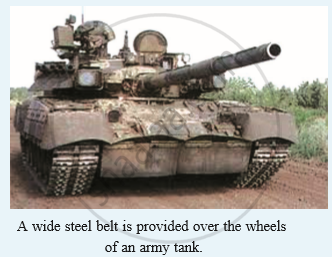
A stone is thrown vertically upwards with initial velocity u reaches a height ‘h’ before coming down. Show that the time taken to go up is the same as the time taken to come down.
An object thrown vertically upwards reaches a height of 500 m. What was its initial velocity? How long will the object take to come back to the earth? Assume g = 10 m/s2.
Choose one or more correct alternatives.
Which of the forces involved in dragging a heavy object on a smooth, horizontal surface, have the same magnitude?
- The horizontal applied force
- gravitational force
- reaction force in vertical direction
- force of friction
How are g and G realated ?
An object falling freely from rest reaches ground in 2 s. If acceleration due to gravity is 9.8 m s-2, then the velocity of object on reaching the ground will be
What is the acceleration due to gravity?
State whether the below statement is True or False.
Neglecting air resistance, a body falling freely near the earth's surface has a constant acceleration.
The free fall of an object is possible only in ______.
Write scientific reasons.
When we drop a feather and a stone at the same time from a height the stone reach the earth faster than a feather.
Write scientific reasons.
The value of gravitational acceleration (g) is taken to be -g when studying the motion of an object thrown upwards in a straight line.
Write the acceleration due to gravity value on the surface of Earth.
Write a short note.
Free Fall
The mass and weight of an object on earth are 5 kg and 49 N respectively. What will be their values on the moon? Assume that the acceleration due to gravity on the moon is 1/6th of that on the earth.
When is free fall possible?
