Advertisements
Advertisements
Question
The sides of a triangle are 35 cm, 54 cm and 61 cm, respectively. The length of its longest altitude ______.
Options
`16sqrt(5)` cm
`10sqrt(5)` cm
`24sqrt(5)` cm
28 cm
Advertisements
Solution
The sides of a triangle are 35 cm, 54 cm and 61 cm, respectively. The length of its longest altitude `underlinebb(24sqrt(5) cm)`.
Explanation:
Given: The sides of a triangle area = 35 cm, b = 54 cm and c = 61 cm, respectively.
So, semi-perimeter of a triangle is:
`s = (a + b + c)/2`
= `(35 + 54 + 61)/2`
= `150/2`
= 75
Area of triangle = `sqrt(s(s - a)(s - b)(s - c))`
= `sqrt(75(75 - 35)(75 - 54)(75 - 61))`
= `sqrt(75 xx 40 xx 21 xx 14)`
= `sqrt(5 xx 5 xx 3 xx 2 xx 2 xx 2 xx 5 xx 3 xx 7 xx 7 xx 2)`
= `5 xx 3 xx 2 xx 2 xx 7sqrt(5)`
= `420sqrt(5)`
As know that,
Area of triangle ABC = `1/2` × Base × Altitude
`1/2` × 35 × Altitude = `420sqrt(5)`
Altitude = `(420sqrt(5) xx 2)/35`
Altitude = `24sqrt(5)`
Therefore, the length of altitude is `24sqrt(5)`.
APPEARS IN
RELATED QUESTIONS
Find the area of a quadrilateral ABCD in which AB = 3 cm, BC = 4 cm, CD = 4 cm, DA = 5 cm and AC = 5 cm.
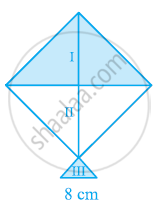
A kite in the shape of a square with a diagonal 32 cm and an isosceles triangles of base 8 cm and sides 6 cm each is to be made of three different shades as shown in the given figure. How much paper of each shade has been used in it?
Find the area of a rhombus whose perimeter is 80 m and one of whose diagonal is 24 m.
Find the area of a quadrilateral ABCD in which AD = 24 cm, ∠BAD = 90° and BCD forms an equilateral triangle whose each side is equal to 26 cm. (Take √3 = 1.73)
Find the perimeter and area of the quadrilateral ABCD in which AB = 17 cm, AD =9 cm, CD = l2cm, ∠ACB = 90° and AC=l5cm.
If the area of an isosceles right triangle is 8 cm2, what is the perimeter of the triangle?
A land is in the shape of rhombus. The perimeter of the land is 160 m and one of the diagonal is 48 m. Find the area of the land.
The length of each side of an equilateral triangle having an area of `9sqrt(3)`cm2 is ______.
The area of an isosceles triangle having base 2 cm and the length of one of the equal sides 4 cm, is ______.
The area of a regular hexagon of side ‘a’ is the sum of the areas of the five equilateral triangles with side a.
