Advertisements
Advertisements
Question

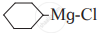
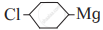
The product ‘B’ in the above reaction sequence is,
Options

Advertisements
Solution

Explanation:
The reaction sequence provided involves the following steps:
1. Formation of the Grignard Reagent:
Cyclohexyl chloride reacts with magnesium in dry ether to form cyclohexyl magnesium chloride, which is a Grignard reagent.
\[\ce{C6H11 - Cl + Mg -> C6H11 - MgCl}\]
2. Hydrolysis of the Grignard Reagent:
The Grignard reagent is then treated with water, leading to the formation of cyclohexane.
\[\ce{C6H11 - MgCl + H2O -> C6H12 + Mg(OH)Cl}\]
APPEARS IN
RELATED QUESTIONS
\[\ce{CH3 - CH = CH2 ->[HI][Peroxide]}\]
The major product of the above reaction is,
Choose the most correct option.
The best method for the preparation of alkyl fluorides is _______.
Choose the most correct option.
Choose the compound from the following that will react fastest by SN1 mechanism
The type of mono halogen derivative in which a halogen atom is bonded to sp3 hybridized carbon atom next to carbon-carbon double bond is ______________
The common name of 1-chloro-2, 2-dimethyl propane is ______.
The bond line formula of 1-iodo-2, 3-dimethyl pentane is
When propene reacts with HCl in presence of peroxide, the product is ________.
The conversion of 2-methylpropan-1-ol to 2-methylpropan-2-ol is ______.
IUPAC name of isobutyl chloride is ______.
Alkyl chloride containing 4° carbon atom(s) would be ____________.
The number of possible monohalogen derivatives for the alkyl halide having molecular formula C4H9X is ____________.
Identify 'B' in the following series of reactions.
\[\ce{Ethanol ->[NaBr][H2SO4, \Delta] A ->[Mg][Dry ether] B}\]
How many asymmetric carbon atoms are present in neopentyl chloride?
Identify A and B respectively in the following conversion.
\[\ce{Ethene ->[A] Bromoethane ->[B][\Delta] Ethyl propionate}\]
The IUPAC name of isobutyl bromide is ____________.
The decreasing order of the rate of nitration of benzene (I), C6D6 (II), nitrobenzene (III), chlorobenzene (IV) is ______.
Complete the following reaction giving major product.
\[\begin{array}{cc}
\ce{CH3}\phantom{.................}\\
|\phantom{...................}\\
\ce{CH3 - C - CH2 - Cl ->[Na/dry either] A}\\
|\phantom{...................}\\
\ce{CH3}\phantom{.................}
\end{array}\]
Identify the chiral molecule from the following.
Identify A and B:
\[\ce{C6H5CH2Br ->[Alc.][KCN] A ->[Na/Ethanol] B}\]
Identify the chiral molecule from the following.
Among the following vinylic halide is ______.
Name the following halide according to IUPAC system and classify them as alkyl, allyl, benzyl (primary, secondary, tertiary), vinyl or aryl halides:
\[\ce{CH3C(C2H5)2CH2Br}\]
