Advertisements
Advertisements
Question
\[\ce{CH3 - CH = CH2 ->[HI][Peroxide]}\]
The major product of the above reaction is,
Options
\[\ce{I - CH2 - CH = CH2}\]
\[\ce{CH3 - CH2 - CH2I}\]
\[\begin{array}{cc}
\ce{CH3-CH-CH3}\\
|\\
\ce{I}\end{array}\]\[\begin{array}{cc}
\ce{CH3-CH-CH2}\\
\phantom{.....}|\phantom{.....}|\\
\phantom{.......}\ce{I}\phantom{....}\ce{OH}
\end{array}\]
Advertisements
Solution
\[\begin{array}{cc}
\ce{CH3-CH-CH3}\\
|\\
\ce{I}\end{array}\]
Explanation:
Identify the effect of peroxide
-
The peroxide (anti-Markovnikov) or Kharasch effect occurs only with HBr.
-
It does not occur with HCl or HI, because the free-radical mechanism is not energetically favorable for these acids.
With HI, the reaction follows the normal (Markovnikov) addition rule, not the peroxide effect.
Hydrogen (H) attaches to the carbon having more hydrogens, and iodine (I) attaches to the more substituted carbon of the double bond.
\[\ce{CH 3 - CH = CH 2 + HI -> CH 3 - CHI - CH 3}\]
This compound is 2-iodopropane.
Reason: Peroxide effect does not operate with HI, so normal (Markovnikov) addition occurs.
APPEARS IN
RELATED QUESTIONS
Choose the most correct option.
The best method for the preparation of alkyl fluorides is _______.
Butanenitrile may be prepared by heating ______.

The product ‘B’ in the above reaction sequence is,
Choose the most correct option.
Which of the following is likely to undergo racemization during alkaline hydrolysis?
(I)
\[\begin{array}{cc}
\ce{CH3-CH-C2H5}\\
|\\
\ce{Cl}\end{array}\]
(II)
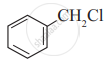
(III)

(IV)
\[\begin{array}{cc}
\ce{\phantom{.......}CH3}\\
\phantom{.....}|\\
\ce{CH3-CH}\\
\phantom{.....}|\\
\ce{\phantom{..........}CH2Cl}
\end{array}\]
Match the pairs.
| Column I | Column II |
| \[\begin{array}{cc} \ce{CH3CH - CH3}\\ |\phantom{.....}\\ \ce{X\phantom{.....}} \end{array}\] |
vinyl halide |
| \[\ce{CH2 = CH - CH2X}\] | alkyl halide |
| \[\ce{CH2 = CH - X}\] | allyl halide |
| benzyl halide | |
| aryl halide |
The type of mono halogen derivative in which a halogen atom is bonded to sp3 hybridized carbon atom next to carbon-carbon double bond is ______________
The bond line formula of 1-iodo-2, 3-dimethyl pentane is
The conversion of 2-methylpropan-1-ol to 2-methylpropan-2-ol is ______.
IUPAC name of isobutyl chloride is ______.
Which of the following compounds is obtained when t-butyl bromide is treated with alcoholic ammonia?
Identify 'B' in the following series of reactions.
\[\ce{Ethanol ->[NaBr][H2SO4, \Delta] A ->[Mg][Dry ether] B}\]
How many asymmetric carbon atoms are present in neopentyl chloride?
The IUPAC name of isobutyl bromide is ____________.
The decreasing order of the rate of nitration of benzene (I), C6D6 (II), nitrobenzene (III), chlorobenzene (IV) is ______.
Complete the following reaction giving major product.
\[\begin{array}{cc}
\ce{CH3}\phantom{.................}\\
|\phantom{...................}\\
\ce{CH3 - C - CH2 - Cl ->[Na/dry either] A}\\
|\phantom{...................}\\
\ce{CH3}\phantom{.................}
\end{array}\]
Identify the chiral molecule from the following.
Identify the chiral molecule from the following.
Identify the chiral molecule from the following.
Among the following vinylic halide is ______.
Name the following halide according to IUPAC system and classify them as alkyl, allyl, benzyl (primary, secondary, tertiary), vinyl or aryl halides:
\[\ce{CH3C(C2H5)2CH2Br}\]
