Advertisements
Advertisements
Question
Butanenitrile may be prepared by heating ______.
Options
propanol with KCN
butanol with KCN
n-butyl chloride with KCN
n-propyl chloride with KCN
Advertisements
Solution
Butanenitrile may be prepared by heating n-propyl chloride with KCN.
Explanation:
Preparation of butanenitrile
\[\ce{CH3 - CH2 CH2Cl + KCN ->[\Delta] CH3 - CH2 - CH2CN + KCl}\]
So, butanenitrile may be prepared by heating Propyl Chloride with \[\ce{KCN}\].
APPEARS IN
RELATED QUESTIONS
The correct order of increasing reactivity of C-X bond towards nucleophile in the following compounds is:
(I)

(II)

(III) (CH3)3 C-X
(IV) (CH3)2 CH-X
Choose the most correct option.
The best method for the preparation of alkyl fluorides is _______.
Choose the most correct option.
Choose the compound from the following that will react fastest by SN1 mechanism

The product ‘B’ in the above reaction sequence is,
Choose the most correct option.
Which of the following is likely to undergo racemization during alkaline hydrolysis?
(I)
\[\begin{array}{cc}
\ce{CH3-CH-C2H5}\\
|\\
\ce{Cl}\end{array}\]
(II)
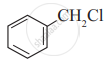
(III)

(IV)
\[\begin{array}{cc}
\ce{\phantom{.......}CH3}\\
\phantom{.....}|\\
\ce{CH3-CH}\\
\phantom{.....}|\\
\ce{\phantom{..........}CH2Cl}
\end{array}\]
The type of mono halogen derivative in which a halogen atom is bonded to sp3 hybridized carbon atom next to carbon-carbon double bond is ______________
When propene reacts with HCl in presence of peroxide, the product is ________.
The conversion of 2-methylpropan-1-ol to 2-methylpropan-2-ol is ______.
IUPAC name of isobutyl chloride is ______.
Alkyl chloride containing 4° carbon atom(s) would be ____________.
Which of the following compounds is obtained when t-butyl bromide is treated with alcoholic ammonia?
What is the IUPAC name of neopentyl chloride?
How many asymmetric carbon atoms are present in neopentyl chloride?
The IUPAC name of isobutyl bromide is ____________.
The decreasing order of the rate of nitration of benzene (I), C6D6 (II), nitrobenzene (III), chlorobenzene (IV) is ______.
Complete the following reaction giving major product.
\[\begin{array}{cc}
\ce{CH3}\phantom{.................}\\
|\phantom{...................}\\
\ce{CH3 - C - CH2 - Cl ->[Na/dry either] A}\\
|\phantom{...................}\\
\ce{CH3}\phantom{.................}
\end{array}\]
Identify the chiral molecule from the following.
Identify the chiral molecule from the following.
Among the following vinylic halide is ______.
