Advertisements
Advertisements
Question
The potential difference between the terminals of a battery of emf 6.0 V and internal resistance 1 Ω drops to 5.8 V when connected across an external resistor. Find the resistance of the external resistor.
Advertisements
Solution
Given:-
Emf of the battery, E = 6 V
Internal resistance, r = 1 Ω
Potential difference, V = 5.8 V
Let R be the resistance of the external resistor.
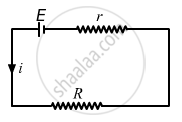
Applying KVL in the above circuit, we get:-
\[E - i(R + r) = 0\]
\[ \Rightarrow i = \frac{E}{R + r}\]
\[ = \frac{6}{R + 1}\]
Also,
\[V = E - ir\]
\[ \Rightarrow 5 . 8 = 6 - \frac{6}{R + 1} \times 1\]
\[\frac{6}{R + 1} = 0 . 2\]
\[R + 1 = \frac{6}{0 . 2} = 30\]
\[R = 29 \Omega\]
APPEARS IN
RELATED QUESTIONS
In the following potentiometer circuit, AB is a uniform wire of length 1 m and resistance 10 Ω. Calculate the potential gradient along the wire and balance length AO (= l).

Describe the working principle of a solar cell. Mention three basic processes involved in the generation of emf.
Why are Si and GaAs preferred materials for solar cells?
Why is potentiometer preferred over a voltmeter for comparison of emf. of cells?
Identify the correct options.
(a) An ammeter should have small resistance.
(b) An ammeter should have large resistance.
(c) A voltmeter should have small resistance.
(d) A voltmeter should have large resistance.
The following figure shows a part of a circuit. If a current of 12 mA exists in the 5 kΩ resistor, find the currents in the other three resistors. What is the potential difference between the points A and B?

Find the potential difference Va – Vb in the circuits shown in the figure.


In the circuit shown in the figure, ε1 = 3 V, ε2 = 2 V, εa = 1 V and r1 = r2 = r3 = 1Ω. Find the potential difference between the points A and B and the current through each branch.

A voltmeter of resistance 400 Ω is used to measure the potential difference across the 100 Ω resistor in the circuit shown in the figure. (a) What will be the reading of the voltmeter? (b) What was the potential difference across 100 Ω before the voltmeter was connected?

A 6-volt battery of negligible internal resistance is connected across a uniform wire AB of length 100 cm. The positive terminal of another battery of emf 4 V and internal resistance 1 Ω is joined to the point A, as shown in the figure. Take the potential at B to be zero. (a) What are the potentials at the points A and C? (b) At which point D of the wire AB, the potential is equal to the potential at C? (c) If the points C and D are connected by a wire, what will be the current through it? (d) If the 4 V battery is replaced by a 7.5 V battery, what would be the answers of parts (a) and (b)?

The potential difference across the terminals of a battery of emf 12 V and internal resistance 2 Ω drops to 10 V when it is connected to a silver voltameter. Find the silver deposited at the cathode in half an hour. Atomic weight of silver is 107.9 g mol−1.
In the circuit in figure the potential difference across P and Q will be nearest to

Two sources of equal e.m.f are connected to an external resistance R in series. The internal resistance of the two sources are R1 and R2 (R2 > R1) If the potential difference across the source having internal. resistance R2 is zero, then ______.
The terminal potential difference of a cell is greater than its e.m.f when it is ______
