Advertisements
Advertisements
प्रश्न
The potential difference between the terminals of a battery of emf 6.0 V and internal resistance 1 Ω drops to 5.8 V when connected across an external resistor. Find the resistance of the external resistor.
Advertisements
उत्तर
Given:-
Emf of the battery, E = 6 V
Internal resistance, r = 1 Ω
Potential difference, V = 5.8 V
Let R be the resistance of the external resistor.
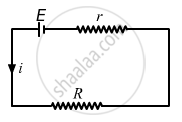
Applying KVL in the above circuit, we get:-
\[E - i(R + r) = 0\]
\[ \Rightarrow i = \frac{E}{R + r}\]
\[ = \frac{6}{R + 1}\]
Also,
\[V = E - ir\]
\[ \Rightarrow 5 . 8 = 6 - \frac{6}{R + 1} \times 1\]
\[\frac{6}{R + 1} = 0 . 2\]
\[R + 1 = \frac{6}{0 . 2} = 30\]
\[R = 29 \Omega\]
APPEARS IN
संबंधित प्रश्न
When 5 V potential difference is applied across a wire of length 0.1 m, the drift speed of electrons is 2.5 x 10⁻⁴ m/s. If the electron density in the wire is 8 x 1028 m-3, calculate the resistivity of the material of the wire.
In a series LCR circuit, what is the phase difference between VL and VC where VL is the potential difference across the inductor and V c is the potential difference across the capacitor?
Why is potentiometer preferred over a voltmeter for comparison of emf. of cells?
The emf of a cell is always greater than its terminal voltage. Why? Give reason.
Identify the correct options.
(a) An ammeter should have small resistance.
(b) An ammeter should have large resistance.
(c) A voltmeter should have small resistance.
(d) A voltmeter should have large resistance.
The current in a conductor and the potential difference across its ends are measured by an ammeter and a voltmeter. The meters draw negligible currents. The ammeter is accurate but the voltmeter has a zero error (that is, it does not read zero when no potential difference is applied). Calculate the zero error if the readings for two different conditions are 1.75 A, 14.4 V and 2.75 A, 22.4 V.
The following figure shows a part of a circuit. If a current of 12 mA exists in the 5 kΩ resistor, find the currents in the other three resistors. What is the potential difference between the points A and B?

Find the potential difference Va – Vb in the circuits shown in the figure.


In the circuit shown in the figure, ε1 = 3 V, ε2 = 2 V, εa = 1 V and r1 = r2 = r3 = 1Ω. Find the potential difference between the points A and B and the current through each branch.

A voltmeter of resistance 400 Ω is used to measure the potential difference across the 100 Ω resistor in the circuit shown in the figure. (a) What will be the reading of the voltmeter? (b) What was the potential difference across 100 Ω before the voltmeter was connected?

A voltmeter consists of a 25 Ω coil connected in series with a 575 Ω resistor. The coil takes 10 mA for full-scale deflection. What maximum potential difference can be measured by this voltmeter?
A copper strip AB and an iron strip AC are joined at A. The junction A is maintained at 0°C and the free ends B and C are maintained at 100°C. There is a potential difference between _______________ .
(a) the two ends of the copper strip
(b) the copper end and the iron end at the junction
(c) the two ends of the iron strip
(d) the free ends B and C
The potential difference across the terminals of a battery of emf 12 V and internal resistance 2 Ω drops to 10 V when it is connected to a silver voltameter. Find the silver deposited at the cathode in half an hour. Atomic weight of silver is 107.9 g mol−1.
A potential difference of 220 V is maintained across 12000 Ω rheostat. Then voltmeter V has a resistance of 6000 Ω and point C is at one fourth the distance from a to b. Then the reading of voltmeter is ______.

