Advertisements
Advertisements
Question
The perimeter of a rectangular field is 500 m and its length = 150 m. Find:
(i) its breadth,
(ii) its area.
(iii) cost of ploughing the field at the rate of ₹1.20 per square meter.
Advertisements
Solution
(i) Perimeter of a rectangle = 2 x (length + breadth)
⇒ 500 m = 2 x (150 m + breadth)
⇒ 250 m – 150 m = breadth
∴ breadth = 100 m
(ii) Area of rectangular field = length x breadth
= 150 m x 100 m
= 15000 m²
(iii) Cost of ploughing the field at the rate of
= ₹ 1.20 per square m²= area of the field x rate of ploughing
= 15000 m² x ₹ 1.20 per square metre
= ₹ 15000 x 1.20 = ₹ 18000
APPEARS IN
RELATED QUESTIONS
Each side of a rectangle is doubled. Find the ratio between :
(i) perimeters of the original rectangle and the resulting rectangle.
(ii) areas of the original rectangle and the resulting rectangle.
A path of uniform width, 2.5 m, runs around the inside of a rectangular field 30 m by 27 m. Find the area of the path.
A rectangular piece of paper has area = 24 cm² and length = 5 cm. Find its perimeter.
Each side of a square tile is 60 cm. How many tiles will be required to cover the floor of a hall with length = 50 m and breadth = 36 m.
Each side of a square is 9 m long. Find its perimeter.
Four rounds of wire fence have to be put around a field. If the field is 60 m long and 40 m wide, how much wire will be needed?
Find the perimeter of the following figure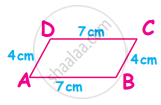
Find the perimeter of the following figure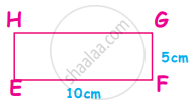

Each rectangle is made out of 12 equal squares, so all have the same area, but the length of the boundary will be different.
Which of these rectangles has the smallest perimeter?
On a centimetre squared paper, make as many rectangles as you can, such that the area of the rectangle is 16 sq cm (consider only natural number lengths).
- Which rectangle has the greatest perimeter?
- Which rectangle has the least perimeter?
- If you take a rectangle of an area of 24 sq cm, what will be your answers?
