Advertisements
Advertisements
Question
The output of a step-down transformer is measured to be 24 V when connected to a 12-watt light bulb. The value of the peak current is ______.
Options
`1/sqrt(2) A`
`sqrt(2) A`
2 A
`2sqrt(2) A`
Advertisements
Solution
The output of a step-down transformer is measured to be 24 V when connected to a 12-watt light bulb. The value of the peak current is `underline(1/sqrt(2) A)`.
Explanation:
It decreases voltage and increases current
|
VS < VP NS < NP ES < EP iS < iP RS < RP tS < tP kS < 1 |
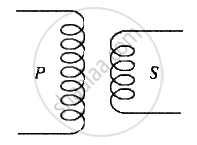
![]() |
According to the problem output/secondary voltage VS = 24 V
Power associated with secondary PS = 12 W
`I_S = P_S/V_S = 12/24` = 0.5 A
Amplitude of the current in the secondary winding
`I _O = I_S sqrt(2)`
= `(0.5)(1.414) = 0.707 = 1/sqrt(2) A`
APPEARS IN
RELATED QUESTIONS
The given graph shows the variation of photo-electric current (I) versus applied voltage (V) for two difference photosensitive materials and for two different intensities of the incident radiations. Identify the pairs of curves that correspond to different materials but same intensity of incident radiation.

The voltage and current in a series AC circuit are given by V = V0cos ωt and i = i0 sin ωt. What is the power dissipated in the circuit?
Can the peak voltage across the inductor be greater than the peak voltage of the source in an LCR circuit?
Can a hot-wire ammeter be used to measure a direct current of constant value? Do we have to change the graduations?
An alternating current is given by i = i1 cos ωt + i2 sin ωt. The rms current is given by
An alternating current of peak value 14 A is used to heat a metal wire. To produce the same heating effect, a constant current i can be used, where i is
Find the time required for a 50 Hz alternating current to change its value from zero to the rms value.
The household supply of electricity is at 220 V (rms value) and 50 Hz. Find the peak voltage and the least possible time in which the voltage can change from the rms value to zero.
An electric bulb is designed to operate at 12 volts DC. If this bulb is connected to an AC source and gives normal brightness, what would be the peak voltage of the source?
The peak power consumed by a resistive coil, when connected to an AC source, is 80 W. Find the energy consumed by the coil in 100 seconds, which is many times larger than the time period of the source.
The dielectric strength of air is 3.0 × 10⁶ V/m. A parallel-plate air-capacitor has area 20 cm2 and plate separation 0.10 mm. Find the maximum rms voltage of an AC source that can be safely connected to this capacitor.
A capacitor of capacitance 10 μF is connected to an oscillator with output voltage ε = (10 V) sin ωt. Find the peak currents in the circuit for ω = 10 s−1, 100 s−1, 500 s−1 and 1000 s−1.
The peak voltage of an ac supply is 300 V. What is the rms voltage?
A circuit containing a 80 mH inductor and a 60 µF capacitor in series is connected to a 230 V, 50 Hz supply. The resistance of the circuit is negligible.
(a) Obtain the current amplitude and rms values.
(b) Obtain the rms values of potential drops across each element.
(c) What is the average power transferred to the inductor?
(d) What is the average power transferred to the capacitor?
(e) What is the total average power absorbed by the circuit?
[‘Average’ implies ‘averaged over one cycle’.]
Do the same with the replacement of the earlier transformer by a 40,000-220 V step-down transformer (Neglect, as before, leakage losses though this may not be a good assumption any longer because of the very high voltage transmission involved). Hence, explain why high voltage transmission is preferred?
If `|vec"A" xx vec"B"| = sqrt3 vec"A" . vec"B"` then the value of is `|vec"A" xx vec"B"|` is
In the Figure below, the current-voltage graphs for a conductor are given at two different temperatures, T1 and T2.

- At which temperature T1 or T2 is the resistance higher?
- Which temperature (T1 or T2) is higher?

