Advertisements
Advertisements
प्रश्न
The output of a step-down transformer is measured to be 24 V when connected to a 12-watt light bulb. The value of the peak current is ______.
विकल्प
`1/sqrt(2) A`
`sqrt(2) A`
2 A
`2sqrt(2) A`
Advertisements
उत्तर
The output of a step-down transformer is measured to be 24 V when connected to a 12-watt light bulb. The value of the peak current is `underline(1/sqrt(2) A)`.
Explanation:
It decreases voltage and increases current
|
VS < VP NS < NP ES < EP iS < iP RS < RP tS < tP kS < 1 |
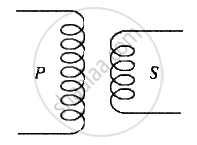
![]() |
According to the problem output/secondary voltage VS = 24 V
Power associated with secondary PS = 12 W
`I_S = P_S/V_S = 12/24` = 0.5 A
Amplitude of the current in the secondary winding
`I _O = I_S sqrt(2)`
= `(0.5)(1.414) = 0.707 = 1/sqrt(2) A`
APPEARS IN
संबंधित प्रश्न
A device X is connected across an ac source of voltage V = V0 sin ωt. The current through X is given as
`I = I_0 sin (omega t + pi/2 )`
1) Identify the device X and write the expression for its reactance.
2) Draw graphs showing the variation of voltage and current with time over one cycle of ac, for X.
3) How does the reactance of the device X vary with the frequency of the ac? Show this variation graphically.
4) Draw the phasor diagram for the device X.
In a series LCR circuit connected to an ac source of variable frequency and voltage ν = vm sin ωt, draw a plot showing the variation of current (I) with angular frequency (ω) for two different values of resistance R1 and R2 (R1 > R2). Write the condition under which the phenomenon of resonance occurs. For which value of the resistance out of the two curves, a sharper resonance is produced? Define Q-factor of the circuit and give its significance.
Two alternating currents are given by `i_1 = i_0 sin wt and i_2 = i_0 sin (wt + pi/3)` Will the rms values of the currents be equal or different?
Can the peak voltage across the inductor be greater than the peak voltage of the source in an LCR circuit?
Can a hot-wire ammeter be used to measure a direct current of constant value? Do we have to change the graduations?
A constant current of 2.8 A exists in a resistor. The rms current is
Find the time required for a 50 Hz alternating current to change its value from zero to the rms value.
The household supply of electricity is at 220 V (rms value) and 50 Hz. Find the peak voltage and the least possible time in which the voltage can change from the rms value to zero.
The dielectric strength of air is 3.0 × 10⁶ V/m. A parallel-plate air-capacitor has area 20 cm2 and plate separation 0.10 mm. Find the maximum rms voltage of an AC source that can be safely connected to this capacitor.
A coil of inductance 5.0 mH and negligible resistance is connected to the oscillator of the previous problem. Find the peak currents in the circuit for ω = 100 s−1, 500 s−1, 1000 s−1.
A resistor of resistance 100 Ω is connected to an AC source ε = (12 V) sin (250 π s−1)t. Find the energy dissipated as heat during t = 0 to t = 1.0 ms.
The rms value of current in an ac circuit is 10 A. What is the peak current?
A circuit containing a 80 mH inductor and a 60 µF capacitor in series is connected to a 230 V, 50 Hz supply. The resistance of the circuit is negligible.
(a) Obtain the current amplitude and rms values.
(b) Obtain the rms values of potential drops across each element.
(c) What is the average power transferred to the inductor?
(d) What is the average power transferred to the capacitor?
(e) What is the total average power absorbed by the circuit?
[‘Average’ implies ‘averaged over one cycle’.]
A small town with a demand of 800 kW of electric power at 220 V is situated 15 km away from an electric plant generating power at 440 V. The resistance of the two wire line carrying power is 0.5 Ω per km. The town gets power from the line through a 4000-220 V step-down transformer at a sub-station in the town.
(a) Estimate the line power loss in the form of heat.
(b) How much power must the plant supply, assuming there is negligible power loss due to leakage?
(c) Characterise the step up transformer at the plant.
Do the same with the replacement of the earlier transformer by a 40,000-220 V step-down transformer (Neglect, as before, leakage losses though this may not be a good assumption any longer because of the very high voltage transmission involved). Hence, explain why high voltage transmission is preferred?
The period of oscillation of a simple pendulum is T = `2π sqrt"L"/"g"`. The measured value of L is 20.0 cm known to have 1 mm accuracy and the time for 100 oscillations of the pendulum is found to be 90 s using a wristwatch of ls resolution. The accuracy in the determination of g is:
In the Figure below, the current-voltage graphs for a conductor are given at two different temperatures, T1 and T2.

- At which temperature T1 or T2 is the resistance higher?
- Which temperature (T1 or T2) is higher?

