Advertisements
Advertisements
Question
The following statement is true or false? Give reason for your answer.
Only one line can pass through a single point.
Options
True
False
Advertisements
Solution
This statement is False.
Explanation:
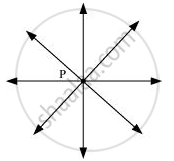
Since, through a single point, an infinite number of lines can pass. In the following figure, it can be seen that there are infinite numbers of lines passing through a single point P.
APPEARS IN
RELATED QUESTIONS
Give a definition of the following term. Are there other terms that need to be defined first? What are they, and how might you define them?
perpendicular lines
Consider two ‘postulates’ given below:-
- Given any two distinct points A and B, there exists a third point C which is in between A and B.
- There exist at least three points that are not on the same line.
Do these postulates contain any undefined terms? Are these postulates consistent? Do they follow from Euclid’s postulates? Explain.
In how many points two distinct lines can intersect?
In how many points two distinct planes can intersect?
The number of dimensions, a surface has ______.
Euclid divided his famous treatise “The Elements” into ______.
‘Lines are parallel, if they do not intersect’ is stated in the form of ______.
Solve the following question using appropriate Euclid’s axiom:
In the following figure, we have ∠1 = ∠2, ∠2 = ∠3. Show that ∠1 = ∠3.

Read the following statement :
An equilateral triangle is a polygon made up of three line segments out of which two line segments are equal to the third one and all its angles are 60° each.
Define the terms used in this definition which you feel necessary. Are there any undefined terms in this? Can you justify that all sides and all angles are equal in a equilateral triangle.
Read the following axioms:
- Things which are equal to the same thing are equal to one another.
- If equals are added to equals, the wholes are equal.
- Things which are double of the same thing are equal to one another.
Check whether the given system of axioms is consistent or inconsistent.
