Advertisements
Advertisements
प्रश्न
The following statement is true or false? Give reason for your answer.
Only one line can pass through a single point.
पर्याय
True
False
Advertisements
उत्तर
This statement is False.
Explanation:
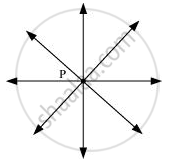
Since, through a single point, an infinite number of lines can pass. In the following figure, it can be seen that there are infinite numbers of lines passing through a single point P.
APPEARS IN
संबंधित प्रश्न
If a point C lies between two points A and B such that AC = BC, point C is called a mid-point of line segment AB. Prove that every line segment has one and only one mid-point.
Why is Axiom 5, in the list of Euclid’s axioms, considered a ‘universal truth’? (Note that the question is not about the fifth postulate.)
How many planes can be made to pass through a line and a point not on the line?
If a quantity B is a part of another quantity A, then A can be written as the sum of B and some third quantity C.
Solve the following question using appropriate Euclid’s axiom:
Two salesmen make equal sales during the month of August. In September, each salesman doubles his sale of the month of August. Compare their sales in September.
Solve the following question using appropriate Euclid’s axiom:
In the following figure, we have ∠1 = ∠2, ∠2 = ∠3. Show that ∠1 = ∠3.

Read the following statement :
An equilateral triangle is a polygon made up of three line segments out of which two line segments are equal to the third one and all its angles are 60° each.
Define the terms used in this definition which you feel necessary. Are there any undefined terms in this? Can you justify that all sides and all angles are equal in a equilateral triangle.
Read the following statements which are taken as axioms:
- If a transversal intersects two parallel lines, then corresponding angles are not necessarily equal.
- If a transversal intersect two parallel lines, then alternate interior angles are equal.
Is this system of axioms consistent? Justify your answer.
Read the following two statements which are taken as axioms:
- If two lines intersect each other, then the vertically opposite angles are not equal.
- If a ray stands on a line, then the sum of two adjacent angles so formed is equal to 180°.
Is this system of axioms consistent? Justify your answer.
Read the following axioms:
- Things which are equal to the same thing are equal to one another.
- If equals are added to equals, the wholes are equal.
- Things which are double of the same thing are equal to one another.
Check whether the given system of axioms is consistent or inconsistent.
