Advertisements
Advertisements
Question
The following statement are true and false .
In a parallelogram, the diagonals intersect each other at right angles .
Advertisements
Solution
False
APPEARS IN
RELATED QUESTIONS
Show that if the diagonals of a quadrilateral are equal and bisect each other at right angles, then it is a square.
ABCD is a rhombus. Show that diagonal AC bisects ∠A as well as ∠C and diagonal BD bisects ∠B as well as ∠D.
The following statement are true and false.
In a parallelogram, the diagonals bisect each other.
The following statement are true and false .
In any quadrilateral, if a pair of opposite sides is equal, it is a parallelogram.
The following statement are true and false .
If all the sides of a quadrilateral are equal it is a parallelogram.
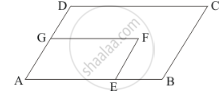
In the given figure, ABCD and AEFG are two parallelograms. If ∠C = 58°, find ∠F.
PQRS is a quadrilateral, PR and QS intersect each other at O. In which of the following case, PQRS is a parallelogram?
∠P =85°, ∠Q = 85°, ∠R = 95°
PQRS is a quadrilateral, PR and QS intersect each other at O. In which of the following case, PQRS is a parallelogram?
PQ = 7 cm, QR = 7 cm, RS = 8 cm, SP = 8 cm
ABCD is a parallelogram, M is the mid-point of BD and BM bisects ∠B. Then ∠AMB =
The diagonals of a parallelogram ABCD intersect at O. If ∠BOC = 90° and ∠BDC = 50°, then ∠OAB =
