Advertisements
Advertisements
Question
ABCD is a parallelogram and E and F are the centroids of triangles ABD and BCDrespectively, then EF =
Options
AE
BE
CE
DE
Advertisements
Solution
Parallelogram ABCD is given with E and F are the centroids of ΔABD and ΔBCD.
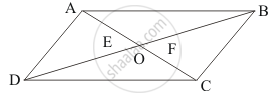
We have to find EF.
We know that the diagonals of a parallelogram of bisect each other.
Thus, AC and BD bisect each other at point O.
Also, median is the line segment joining the vertex to the mid-point of the opposite side of the triangle. Therefore, the centroids E and F lie on AC.
Now, the centroid divides each median into two segments whose lengths are in the ratio 2:1, with the longest one nearest the vertex.
Then, in ΔABD, we get:
`(AE)/(EO) = 2/1`
Or,
`(EO) = 1/3`and (AE) = 2/3 AO`…… (I)
Similarly, in ΔABD,we get:
`FO = 1/3 CO `and `CF = 2/3 CO`…… (II)
Also,
AO = CO
`1/3 AO = 1/3CO`
From (I) and (II), we get:
EO = FO
And EF = 2FO…… (III)
Also, from (II) and (III), we get :
CF = AE …… (IV)
Now, from (I),
`AE = 2/3 AO`
`AE = 2/3 CO`
`AE = 2/3 (CF +FO`
From (IV), we get:
`AE = 2/3 (AE + FO)`
`AE = 2/3 AE + 2/3 FO`
`AE - 2/3 AE = 2/3 FO`
`1/3 AE = 2/3 FO`
From(III):
`1/3 AE = 1/3 EF`
AE = EF
Hence the correct choice is (a).
APPEARS IN
RELATED QUESTIONS
Show that if the diagonals of a quadrilateral bisect each other at right angles, then it is a rhombus.
ABCD is a rhombus. Show that diagonal AC bisects ∠A as well as ∠C and diagonal BD bisects ∠B as well as ∠D.
In a parallelogram ABCD, ∠D = 135°, determine the measures of ∠A and ∠B
The following statement are true and false .
In a parallelogram, the diagonals are equal
The following statement are true and false.
In a parallelogram, the diagonals bisect each other.
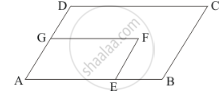
In the given figure, ABCD and AEFG are two parallelograms. If ∠C = 58°, find ∠F.
Complete the following statement by means of one of those given in brackets against each:
If one angle of a parallelogram is a right angle, then it is necessarily a .................
The figure formed by joining the mid-points of the adjacent sides of a quadrilateral is a
The figure formed by joining the mid-points of the adjacent sides of a rectangle is a
If one angle of a parallelogram is 24° less than twice the smallest angle, then the measure of the largest angle of the parallelogram is
