English
Karnataka Board PUCPUC Science Class 11

The Following Figure Shows Three Equidistant Slits Being Illuminated by a Monochromatic Parallel Beam of Light. - Physics

Advertisements
Advertisements

Question

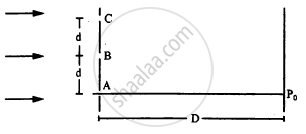
The following figure shows three equidistant slits being illuminated by a monochromatic parallel beam of light. Let \[B P_0  - A P_0  = \lambda/3\text{ and }D >  > \lambda.\] (a) Show that in this case \[d = \sqrt{2\lambda D/3}.\] (b) Show that the intensity at P0 is three times the intensity due to any of the three slits individually.
Sum
Advertisements

Solution

(a) Given:-

Wavelength of light = \[\lambda\]

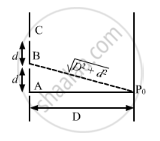
Path difference of wave fronts reaching from A and B is given by

\[∆  x_B  =  {BP}_0  -  {AP}_0  = \frac{\lambda}{3}\]

\[ \Rightarrow \sqrt{D^2 + d^2} - D = \frac{\lambda}{3}\]

\[ \Rightarrow  D^2  +  d^2  =    D^2  + \frac{\lambda^2}{9}   + \frac{2\lambda D}{3}\]

We will neglect the term \[\frac{\lambda^2}{9},\] as it has a very small value.

\[\therefore d = \sqrt{\frac{\left( 2\lambda D \right)}{3}}\]

(b) To calculating the intensity at P0consider the interference of light waves coming from all the three slits.

Path difference of the wave fronts reaching from A and C is given by

\[{CP}_0 - {AP}_0 = \sqrt{D^2 + \left( 2d \right)^2} - D\]

\[ = \sqrt{D^2 + \frac{8\lambda D}{3}} - D ........\left(\text{Using the value of d from part a} \right)\]

\[ = D \left\{ 1 + \frac{8\lambda}{3D} \right\}^\frac{1}{2} - D\]

Expanding the value using binomial theorem and neglectingthe higher order terms, we get

\[ D\left\{ 1 + \frac{1}{2} \times \frac{8\lambda}{3D} + . . . \right\} - D\]

\[{CP}_0 - {AP}_0 = \frac{4\lambda}{3}\]

So, the corresponding phase difference between the wave fronts from A and C is given by

\[\phi_c = \frac{2\pi ∆ x_C}{\lambda} = \frac{2\pi \times 4\lambda}{3\lambda}\]

\[ \Rightarrow \phi_c = \frac{8\pi}{3}\text{ or }\left( 2\pi + \frac{2\pi}{3} \right)\]

\[ \Rightarrow \phi_c = \frac{2\pi}{3}...........(1)\]

Again, \[\phi_B = \frac{2\pi ∆ x_B}{\lambda}\]

\[ \Rightarrow \phi_B = \frac{2\pi\lambda}{3\lambda} = \frac{2\pi}{3}..........(2)\]

So, it can be said that light from B and C are in the same phase, as they have the same phase difference with respect to A.

Amplitude of wave reaching P0 is given by

\[A = \sqrt{\left( 2a \right)^2 + a^2 + 2a \times a\cos\left( \frac{2\pi}{3} \right)}\]

\[               = \sqrt{4 a^2 + a^2 + 2 a^2 \sqrt{3}}\]

\[ \therefore  l_{po}  = K   \left( \sqrt{3}  r \right)^2  = 3  K r^2  = 3l\]

Here, I is the intensity due to the individual slits and Ipo is the total intensity at P0.

Thus, the resulting amplitude is three times the intensity due to the individual slits.
shaalaa.com
Refraction of Monochromatic Light
  Is there an error in this question or solution?
Chapter 17: Light Waves - Exercise [Page 382]

APPEARS IN

HC Verma Concepts of Physics Vol. 1 [English] Class 11 and 12
Chapter 17 Light Waves
Exercise | Q 28 | Page 382

RELATED QUESTIONS

'Two independent monochromatic sources of light cannot produce a sustained interference pattern'. Give reason.


Two monochromatic rays of light are incident normally on the face AB of an isosceles right-angled prism ABC. The refractive indices of the glass prism for the two rays '1' and '2' are respectively 1.3 and 1.5. Trace the path of these rays after entering the prism.


Two monochromatic rays of light are incident normally on the face AB of an isosceles right-angled prism ABC. The refractive indices of the glass prism for the two rays '1' and '2' are respectively 1.35 and 1.45. Trace the path of these rays after entering the prism.


What kind of fringes do you expect to observe if white light is used instead of monochromatic light?


State the essential conditions for diffraction of light ?


When monochromatic light travels from a rarer to a denser medium, explain the following, giving reasons:

(i) Is the frequency of reflected and refracted light same as the frequency of incident light?

(ii) Does the decrease in speed imply a reduction in the energy carried by light wave?


When monochromatic light is incident on a surface separating two media, why does the refracted light have the same frequency as that of the incident light?


Obtain the conditions for the bright and dark fringes in diffraction pattern due to a single narrow slit illuminated by a monochromatic source.

Explain clearly why the secondary maxima go on becoming weaker with increasing.


Which of the following sources provides the best monochromatic light?


Find the angle of incidence at which a ray of monochromatic light should be incident on the first surface AB of a regular glass prism ABC so that the emergent ray grazes the adjacent surface AC. (Refractive Index of glass = 1 .56)


Monochromatic fight of wavelength 198 nm is incident on the surface of a metallic cathode whose work function is 2.5 eV How much potential difference must be applied between the cathode and the anode of a photocell to just stop the photocurrent from flowing? 


Answer the following question.
In the diffraction due to a single slit experiment, the aperture of the slit is 3 mm. If monochromatic light of wavelength 620 nm is incident normally on the slit, calculate the separation between the first order minima and the 3rd order maxima on one side of the screen. The distance between the slit and the screen is 1.5 m.


Using the monochromatic light of the wavelength in the experimental set-up of the diffraction pattern as well as in the interference pattern where the slit separation is 1 mm, 10 interference fringes are found to be within the central maximum of the diffraction pattern. Determine the width of the single slit, if the screen is kept at the same distance from the slit in the two cases.


A monochromatic ray of light falls on a regular prism under minimum deviation condition. What is the relation between angle of incidence and angle of emergence?


Monochromatic light of wavelength 600 nm is incident from the air on a water surface. The refractive index of water is 1.33. Find the

  1. wavelength,
  2. frequency and
  3. speed, of reflected and refracted light.

A ray of monochromatic light propagating in the air is incident on the surface of the water. Which of the following will be the same for the reflected and refracted rays?


The Figure below shows a ray of monochromatic light LM incident on the first surface AB of a regular (equilateral) glass prism ABC. The emergent ray grazes the adjacent surface AC. Calculate the angle of incidence. (Refractive Index of glass = 1.5)


Share
Notifications

Englishहिंदीमराठी


      Forgot password?
Use app×