Advertisements
Advertisements
Question
The exterior angles, obtained on producing the base of a triangle both way are 104° and 136°. Find all the angles of the triangle.
Advertisements
Solution
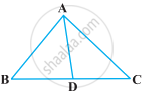
In the given problem, the exterior angles obtained on producing the base of a triangle both ways are 104° and 136°. So, let us draw ΔABC and extend the base BC, such that:
∠ACD = 104°
∠ABE = 136°
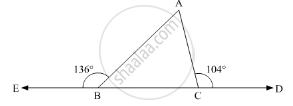
Here, we need to find all the three angles of the triangle.
Now, since BCD is a straight line, using the property, “angles forming a linear pair are supplementary”, we get
∠ACB + ∠ADC = 180°
∠ACB + 104° = 180°
∠ACB = 180° – 104°
∠ACB = 76°
Similarly, EBC is a straight line, so we get,
∠ABC + ∠ABE = 180°
∠ABC + 136° = 180°
∠ABC = 44
Further, using angle sum property in ΔABC
∠ABC + ∠ACB + ∠BAC = 180°
44 + 76 + ∠BAC = 180°
∠ABC = 180° – 120°
∠ABC = 60°
Therefore, ∠ACB = 76°, ∠BAC = 60°, ∠ABC = 44°.
APPEARS IN
RELATED QUESTIONS
Is the following statement true and false :
An exterior angle of a triangle is greater than the opposite interior angles.
Fill in the blank to make the following statement true:
A triangle cannot have more than ...... right angles.
In ΔPQR, If ∠R > ∠Q then ______.
Calculate the unknown marked angles of the following figure :
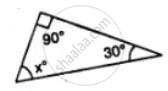
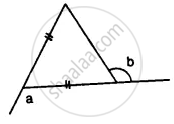
In the given figure, express a in terms of b.
The length of the sides of the triangle is given. Say what types of triangles they are 3.7 cm, 3.4 cm, 4 cm.
In ΔABC, name the 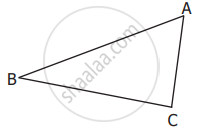
a) Three sides: _________, __________, __________
b) Three Angles: _________, __________, __________
c) Three Vertices: _________, __________, __________
In the following figure, AD is the bisector of ∠BAC. Prove that AB > BD.
The number of triangles in the following figure is ______.

Can we have two acute angles whose sum is an acute angle? Why or why not?
