Advertisements
Advertisements
Question
The diagram given below represents the spinal cord of a mammal, seen in a transverse section together with the nerves. Study the diagram and then answer the questions given below:
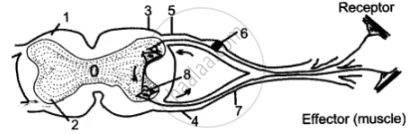
(i) Label the parts 1—8 indicated by guidelines.
(ii) What do the arrows indicate? What is the pathway indicated termed?
(iii) What type of nerve is shown in the diagram?
Advertisements
Solution
(i)
- White matter
- Gray matter
- Dorsal root
- Ventral root
- Dorsal ganglion
- Sensory neuron
- Spinal nerve
- Synapse
(ii) The arrows indicate the arrangement of white and gray matter is reversed from that in the brain. The patl4way indicated is termed as a nerve pathway in a simple spinal reflex.
(iii) Sensory or Afferent nerve.
RELATED QUESTIONS
Name the following:
Inability to speak.
Where is this located?
Meninges
Where is this located?
Ganglia
Choose the correct answer.
Number of spinal nerves in human beings ______________
Give Technical Term:
The fluid which fills the central canal of the spinal cord.
Sketch and label T. S. of Spinal cord.
Spinal cord is enclosed in ____________ of vertebral column.
Spinal nerves are usually ______
In humans, the number of spinal nerves are ______.
Given below is the transverse section of the spinal cord. Read the information below the diagram and fill in the blanks:
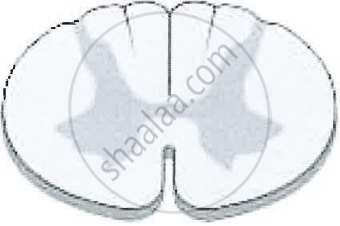
The spinal cord extends from the medulla oblongata of the brain and runs down through the whole length of the vertebral column. The spinal cord is covered by the meninges. It conducts impulses from the skin and muscles to the brain. It also conducts impulses from the brain to the muscles of the trunk and limbs.
The spinal cord is a part of the (a) ______ Nervous System. The grey matter in the picture given above consists of (b) ______ while the white matter consists of (c) ______. The spinal cord is concerned with the (d) ______ actions below the neck. (e) ______ is the bony structure that protects the spinal cord.
