Advertisements
Advertisements
प्रश्न
The diagram given below represents the spinal cord of a mammal, seen in a transverse section together with the nerves. Study the diagram and then answer the questions given below:
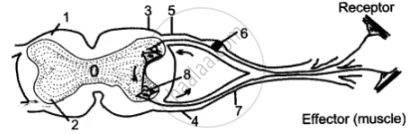
(i) Label the parts 1—8 indicated by guidelines.
(ii) What do the arrows indicate? What is the pathway indicated termed?
(iii) What type of nerve is shown in the diagram?
Advertisements
उत्तर
(i)
- White matter
- Gray matter
- Dorsal root
- Ventral root
- Dorsal ganglion
- Sensory neuron
- Spinal nerve
- Synapse
(ii) The arrows indicate the arrangement of white and gray matter is reversed from that in the brain. The patl4way indicated is termed as a nerve pathway in a simple spinal reflex.
(iii) Sensory or Afferent nerve.
संबंधित प्रश्न
Describe T.S. of the spinal cord.
Distinguish between the following pair of words:
Motor and sensory nerve
Give one point of difference between the following on the basis of what is indicated:
Cerebrum and spinal cord. (Arrangement of neurons)
There are ______ pairs of cranial nerves and ______ pairs of spinal nerves.
Which neuron conducts impulse from the spinal cord to the effector organ?
Which statement is correct regarding spinal nerves in man?
______ connects the brain to a different part of the body through nerves.
How are cytons and axons arranged in the spinal cord?
Spinal nerves are usually ______
Explain the formation of a typical spinal nerve with the help of a neat labelled diagram.
