Advertisements
Advertisements
Question
The diagram given below represents a section of the human heart. Answer the questions that follow:
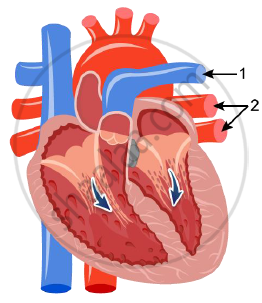
- Which parts of heart are in the diastolic phase? Give a reason to support your answer.
- Label the parts numbered 1 and 2 in the diagram. What type of blood flows through them?
- What causes the heart sounds ‘LUBB’ and ‘DUP’?
- Name the blood vessels that supply oxygenated blood to the heart muscles.
- Draw neat labelled diagrams of a cross section of an artery and a vein.
Advertisements
Solution
- Ventricles are in the diastolic phase. The arrows indicate blood entering the ventricles. During a ventricular diastole, the valves between atria and ventricles open which allow the entry of blood into the ventricles.
- 1: Pulmonary artery
2: Pulmonary veins - Closing of the bicuspid and tricuspid valves causes the ‘LUBB’ sound, and the closing of semilunar valves causes the ‘DUP’ sound.
- Coronary arteries supply oxygenated blood to the heart muscles.

APPEARS IN
RELATED QUESTIONS
Name the following:
The valve present in between the chambers on the right side of the human heart.
Differentiate between members of the following pairs with reference to the aspect asked within bracket:
artery and vein (type of blood primarily flowing through)
Fill in the blanks with suitable words given below:
The carbon dioxide loaded blood from right ventricle is pumped into the lungs through ______.
Which side of the heart (left or right) contains oxygenated blood?
Name the three kinds of blood vessels found in human beings. With the help of suitable diagrams, differentiate between them.
Multiple choice questions. Tick ( ✓ ) the correct choice:
The four blood groups in humans are
Define the Veins.
Complete the following sentence with appropriate word:
Beside food, oxygen and waste materials, circulatory system transports ________ to various parts of the body.
Complete the following sentence with appropriate word:
The chamber of heart which pumps blood into aorta is __________.
The process of keeping the blood flowing continuously throughout the body.
