Advertisements
Advertisements
Question
Name the three kinds of blood vessels found in human beings. With the help of suitable diagrams, differentiate between them.
Advertisements
Solution
The three kind of blood vessels found in human beings are arteries, veins and capillaries.
- Arteries are the blood vessels that carry blood from the heart to the various parts of the body.
- Veins are the blood vessels that carry blood from the body parts to the heart
- Capillaries: These are the terminal branches of an artery, which rejoin to form a vein. A capillary is a very narrow tube whose walls have a single layer of cells with no muscles. Although the wall of a capillary is very thin, yet an exchange of nutrients, waste products and gases take place between the blood and the body fluids.
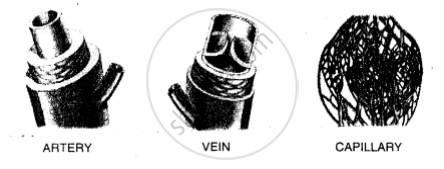
Differences:
Arteries
- Carry blood away from the heart.
- Have thick and more muscular walls.
- Carry oxygenated blood (except pulmonary artery which carries deoxygenated blood).
- The blood flows with jerks and under great force.
Veins
- Carry blood towards the heart.
- Have thin and less muscular walls.
- Carry deoxygenated blood (except pulmonary vein which carries oxygenated blood).
- The blood flows smoothly and under little pressure
Capillaries
- Arteries after entering an organ divide into number of smaller branches called arterioles which further divide repeatedly to form a network of fine branches called capillaries.
- The walls of the capillaries are very thin and are one cell deep.
- The Capillaries after the metabolic exchange unite to form larger vessels called venules, which again unite to form a vein.
APPEARS IN
RELATED QUESTIONS
Blood in the pulmonary artery or pulmonary vein (Which one contains less oxyhaemoglobin?)
Mention the exact location of the Pulmonary semilunar valve
Differentiate between members of the following pairs with reference to the aspect asked
within bracket:
Erythrocytes and leucocytes (function)
Fill in the blank:
In human body, heart is located on the _____ side of the chest cavity.
_____ gas is transported to all parts of the body.
A female has haemophilic brother and parents having nonual blood clotting. She marries a male who has no history of haemophilia in his family. What is the possibility of her children having this disease?
Identify the INCORRECT match
Assertion (A): RBCs help in the transport of respiratory gases.
Reason (R): The cytoplasm of RBCs contains the respiratory pigment Haemoglobin.
A resting person usually has a pulse rate between 72 to 80 beats per minute.
Which component of the haemoglobin molecule combines with the oxygen molecule to form oxyhaemoglobin?
