Advertisements
Advertisements
प्रश्न
Name the three kinds of blood vessels found in human beings. With the help of suitable diagrams, differentiate between them.
Advertisements
उत्तर
The three kind of blood vessels found in human beings are arteries, veins and capillaries.
- Arteries are the blood vessels that carry blood from the heart to the various parts of the body.
- Veins are the blood vessels that carry blood from the body parts to the heart
- Capillaries: These are the terminal branches of an artery, which rejoin to form a vein. A capillary is a very narrow tube whose walls have a single layer of cells with no muscles. Although the wall of a capillary is very thin, yet an exchange of nutrients, waste products and gases take place between the blood and the body fluids.
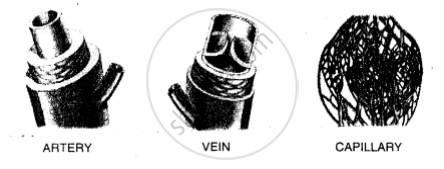
Differences:
Arteries
- Carry blood away from the heart.
- Have thick and more muscular walls.
- Carry oxygenated blood (except pulmonary artery which carries deoxygenated blood).
- The blood flows with jerks and under great force.
Veins
- Carry blood towards the heart.
- Have thin and less muscular walls.
- Carry deoxygenated blood (except pulmonary vein which carries oxygenated blood).
- The blood flows smoothly and under little pressure
Capillaries
- Arteries after entering an organ divide into number of smaller branches called arterioles which further divide repeatedly to form a network of fine branches called capillaries.
- The walls of the capillaries are very thin and are one cell deep.
- The Capillaries after the metabolic exchange unite to form larger vessels called venules, which again unite to form a vein.
APPEARS IN
संबंधित प्रश्न
Given below is a certain structure, write its chief functional activity.
Erythrocytes - ______.
Note the relationship between the first two words and suggest a suitable word/words for the fourth place:
Coronary artery : Heart :: Hepatic artery : ______
Give reason for the following:
The arteries are deep seated in the body
Draw a neat and labelled diagram.
Internal structure of the heart.
Find the odd one out.
Draw the structure of human heart and label its parts
Differentiate between:
Red blood cells (RBC) and White blood cells (WBC)
Reduction in number of ______ can cause clotting disorder, leading to excessive loss of blood from the body.
Which of the following is TRUE regarding closed circulatory system?
Given diagram is a schematic representation of the circulatory system in humans. Study the same and answer the questions that follow:
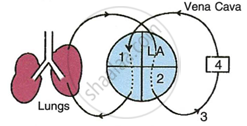 |
- Label the parts 1 and 4 indicated in the diagram.
- Which of the above mentioned number is the thickest artery? Also write its name.
- Mention the number and chamber of the heart which has the thickest muscular wall.
- Which of the above numbers/structures has the maximum number of blood capillaries?
- Draw neat and labelled diagrams of the transverse section of vena cava and the part numbered as 3. Make sure to show the structural differences between these two in the diagram.
