Advertisements
Advertisements
प्रश्न
Name the three kinds of blood vessels found in human beings. With the help of suitable diagrams, differentiate between them.
Advertisements
उत्तर
The three kind of blood vessels found in human beings are arteries, veins and capillaries.
- Arteries are the blood vessels that carry blood from the heart to the various parts of the body.
- Veins are the blood vessels that carry blood from the body parts to the heart
- Capillaries: These are the terminal branches of an artery, which rejoin to form a vein. A capillary is a very narrow tube whose walls have a single layer of cells with no muscles. Although the wall of a capillary is very thin, yet an exchange of nutrients, waste products and gases take place between the blood and the body fluids.
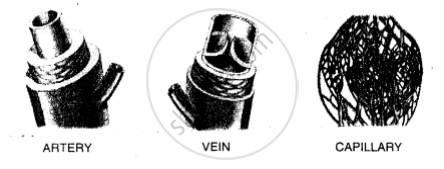
Differences:
Arteries
- Carry blood away from the heart.
- Have thick and more muscular walls.
- Carry oxygenated blood (except pulmonary artery which carries deoxygenated blood).
- The blood flows with jerks and under great force.
Veins
- Carry blood towards the heart.
- Have thin and less muscular walls.
- Carry deoxygenated blood (except pulmonary vein which carries oxygenated blood).
- The blood flows smoothly and under little pressure
Capillaries
- Arteries after entering an organ divide into number of smaller branches called arterioles which further divide repeatedly to form a network of fine branches called capillaries.
- The walls of the capillaries are very thin and are one cell deep.
- The Capillaries after the metabolic exchange unite to form larger vessels called venules, which again unite to form a vein.
APPEARS IN
संबंधित प्रश्न
Aqueous humour, Vitreous humour, lris, Central canal
Differentiate between LUBB and DUP (names of the valves whose closure produce the sound)
Differentiate between members of the following pairs with reference to the aspect asked within bracket:
artery and vein (type of blood primarily flowing through)
Production of RBCs occurs in ______.
What is meant by the term 'double circulation' of blood in mammals? What is diastole?
You can see some blood vessels on the outside of the hands specially in older people. Are those veins or arteries? How can you confirm your answer?
The endocrine glands produce chemical substances called ____
In which of the following process blood neutrophils play an important role?
Spleen is referred to as ______.
What are the normal values of blood pressure in a normal human adult?
