Advertisements
Advertisements
प्रश्न
The diagram given below represents a section of the human heart. Answer the questions that follow:
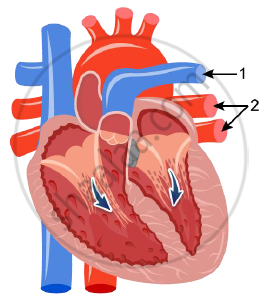
- Which parts of heart are in the diastolic phase? Give a reason to support your answer.
- Label the parts numbered 1 and 2 in the diagram. What type of blood flows through them?
- What causes the heart sounds ‘LUBB’ and ‘DUP’?
- Name the blood vessels that supply oxygenated blood to the heart muscles.
- Draw neat labelled diagrams of a cross section of an artery and a vein.
Advertisements
उत्तर
- Ventricles are in the diastolic phase. The arrows indicate blood entering the ventricles. During a ventricular diastole, the valves between atria and ventricles open which allow the entry of blood into the ventricles.
- 1: Pulmonary artery
2: Pulmonary veins - Closing of the bicuspid and tricuspid valves causes the ‘LUBB’ sound, and the closing of semilunar valves causes the ‘DUP’ sound.
- Coronary arteries supply oxygenated blood to the heart muscles.

APPEARS IN
संबंधित प्रश्न
Name the following:
The blood vessel which supplies blood to the liver.
Given below is a certain structure, write its chief functional activity.
Lymphocytes - ______.
How do you account for the following difference?
The left ventricle has thicker walls than the right ventricle.
How do you account for the following difference?
The walls of the right ventricle are thicker than those of the right auricle.
Given below is a highly schematic diagram of the human blood circulatory system.
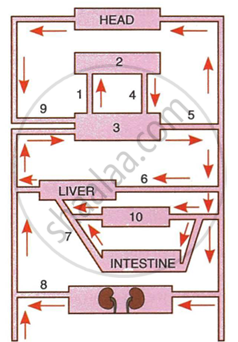 |
- Which part (state the number) represents the heart? Give reason in support of your answer.
- Which numbers represent the following, respectively?
Aorta Superior vena cava Hepatic portal vein Renal Vein Pulmonary artery Stomach
The oxygen-rich blood from the lungs comes into the ______ of the heart.
Find the odd one out, giving reason.
Mention, if the following statement is True or False. If false rewrite the wrong statement in its correct form:
Leucocytes show amoeboid movement.
Long answer question:
Describe human blood and give its functions.
Mention the phase of heart beat in which both the atrio-ventricular valves are closed.
