Advertisements
Online Mock Tests
Chapters
1: Cell Division
2: Structure of Chromosomes
3: Principles of Genetics
Unit-2 Plant Physiology
4: Absorption by Roots
5: Transpiration
6: Photosynthesis
7: Chemical Coordination in Plants
▶ 8: Circulatory System
Unit-3 Human Anatomy and Physiology
9: Excretory System
10: Nervous System
11: Endocrine System
12: Reproductive System
13: Human Population
14: The Evolution of Man
15: Theories of Evolution
16: Types of Pollution
17: Sources of Pollution and Major Pollutants
18: Effects of Pollution
19: Abatement of Pollution
20: Greenhouse Effects, Global Warming, Ozone Layer Depletion and Acid Rain
![Frank solutions for बायोलॉजी पार्ट २ [इंग्रजी] इयत्ता १० आयएससी chapter 8 - Circulatory System - Shaalaa.com](/images/biology-part-2-english-class-10-icse_6:4cd9978ddb1c4f42b0b0e9ec6f09c057.jpg "Frank solutions for बायोलॉजी पार्ट २ [इंग्रजी] इयत्ता १० आयएससी chapter 8 - Circulatory System")
Advertisements
Solutions for Chapter 8: Circulatory System
Below listed, you can find solutions for Chapter 8 of CISCE Frank for बायोलॉजी पार्ट २ [इंग्रजी] इयत्ता १० आयएससी.
Frank solutions for बायोलॉजी पार्ट २ [इंग्रजी] इयत्ता १० आयएससी 8 Circulatory System Exercises [Pages 116 - 122]
Choose the correct answer:
How much blood is present in an average person?
1 l
2 l
4 l
5 l
Choose the correct answer:
Which chamber of the heart has the thickest wall?
Right atrium
Left atrium
Left ventricle
Right ventricle
Exchange of nutrients between blood and tissues occurs at the ______.
veins
capillaries
arteries
venule
Choose the correct answer:
Both erythrocytes and leucocytes form in the _________
bone marrow
thymus
tonsil
lymphnode
Choose the correct answer:
The life-span of RBC is _________
one month
100 days
120 days
100 hours
The rate of heartbeat per minute in a adult man is ______.
74-80
70-80
80-90
64-72
Choose the correct answer:
The amount of water present in blood plasma is __________
60%
70%
80%
90%
Choose the correct answer:
English physician who discovered blood circulation was ___________
J.C. Bose
A. Vesalins
William Harvery
H.G. Khurana
Choose the correct answer:
Which of the following is termed as the 'graveyard' of R.B.C.?
Liver
Spleen
Kidney
Bone marrow
Choose the correct answer:
The E.C.G. is used to detect ____________
heart attack
heart block
coronary thrombosis
all the above
Choose the correct answer:
Universal blood donor group is ___________
A
B
AB
O
The heart sound 'Dub' is produced when ______.
Semilunar valves open
Atria ventricular valves close
Semilunar valves close
Atria ventricular valves open
The life span of an RBC is ______.
120 days
220 days
20 days
2 weeks
Oxygenated blood to the liver is supplied by ______.
Hepatic artery
Hepatic vein
Inferior vena cava
Hepatic portal vein
If a person has a heart attack, what must be done immediately?
P. Loosen his/her clothing
Q. Make him/her lie down in an airy room
R. Rush him/her to the hospital
S. Engage him/her in a conversation
P and Q
P and S
R and S
P, Q and R
Multiple Choice Questions
Agranulocytes are:
Lymphocytes, monocytes
Lymphocytes, basophils
Eosinophils, basophils
Eosinophils, monocytes
Assertion (A): Alveoli contain an extensive network of blood vessels.
Reason (R): Alveoli are the site where exchange of gases occurs.
Both A and R are true and R is the correct explanation of A.
Both A and R are true but R is not the correct explanation of A.
A is true but R is false.
A is false but R is true.
Assertion (A): There is no mixing of oxygenated and deoxygenated blood in the human heart.
Reason (R): Valves are present in the heart which allows the movement of blood in one direction only.
Both A and R are true and R is the correct explanation of A.
Both A and R are true but R is not the correct explanation of A.
A is true but R is false.
A is false but R is true.
Assertion (A): Valves are present in the arteries.
Reason (R): Arteries carry oxygenated blood from heart to different body parts except pulmonary artery.
Both A and R are true and R is the correct explanation of A.
Both A and R are true but R is not the correct explanation of A.
A is true but R is false.
A is false but R is true.
Name the following:
An iron-containing protein in the blood of many animals in the red blood cells.
Name the following:
Contraction of heart
Name the following:
Relaxation of heart.
Name the following:
Slowing of heartbeat than normal rate.
Name the following:
The rhythmic dilation of an artery generated by the opening and closing of the aortic valve in the heart.
Name the following:
The organization which procures and supplies blood during an emergency.
Name the following:
The blood vessel which supplies blood to the liver.
Give appropriate biological or technical terms for the following:
Squeezing out of white blood cells from the capillaries into the surrounding tissues.
Name the following:
The relaxation phase of the heart.
The compound formed when haemoglobin combines with carbon dioxide in blood.
Name the following:
A genetic disorder in which the blood does not clot.
Name the following:
The iron containing pigment in the erythrocytes.
Choose the ODD one out from the following terms given and name the CATEGORY to which the others belong:
Lumen, muscular tissue, connective tissue, pericardium
Choose the ODD one out from the following terms given and name the CATEGORY to which the others belong:
Prostate gland, Cowper’s gland, seminal vesicle, seminiferous tubules.
Select the odd one in the following:
RBC, WBC, Blood platelets, Histone.
Select the odd one in the following:
Tricuspid, Bicuspid, Semilunar, Foramen ovales.
Select the odd one in the following:
Artery, Vein, Capillary, Nerve.
Select the odd one in the following:
Monocytes, Lymphocytes, Basophils, RBC
Select the odd one from the following:
Prothrombin
Thrombin
Fibrinogen
Albumin
Differentiate between LUBB and DUP (names of the valves whose closure produce the sound)
Blood in the renal artery or renal vein (Which one has more urea?)
Blood in the pulmonary artery or pulmonary vein (Which one contains less oxyhaemoglobin?)
Rewrite and complete the following sentence by inserting the correct word.
Oxygen combines with haemoglobin present in RBCs and forms ______.
Mention the exact location of the Pulmonary semilunar valve
On the inside, the heart is a ______, hollow organ. It is divided into the left and right side by a muscular wall called the ______. The right and left sides of the ______ are further divided into two top chambers called the ______, which receive blood from the veins, and two bottom chambers called ______, which pump blood into the ______.
Describe the circulatory system of humans.
Explain the following:
Why is the SA node called the pace-maker of the heart?
Explain the following:
Why is there no mixing of deoxygenated and oxygenated blood in the human heart normally?
Why does the left ventricle possess a thicker wall than the right ventricle?
State the function:
Bicuspid valve
State the function:
Tricuspid valve
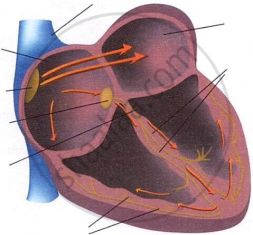
Label the following diagram:
The diagram given alongside shows the cross-section of two kinds of blood vessels:
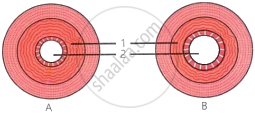
- Identify the blood vessels A and B. In each case give a reason to support your answer.
- Name the parts numbered 1 and 2.
- Name the blood vessel that
- begins and ends in capillaries.
- supplies blood to the walls of the heart.
The diagram given alongside represents the human heart in one phase of its functional activities. Study the same and answer the question that follow:
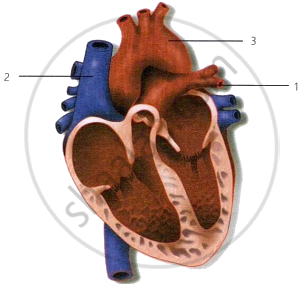
- Name the phase.
- Label the parts 1, 2 and 3.
- Which part of the heart is contracting in this phase?
- Draw well labelled diagram of part 1 and 2 to show the structural differences between them.
The diagram below represents the simplified pathway of the circulation of blood. Study the same and answer the questions which follow:

(i) Name the blood vessels labelled 1 and 2.
(ii) State the function of blood vessels labelled 5 and 8.
(iii) What is the importance of the blood vessel labelled 6?
(iv) Which blood vessel will contain a high amount of glucose and amino acids after a meal?
(v) Draw a diagram of the different blood cells as seen in a smear of human blood.
The diagrams given below are cross sections of blood vessels:

(i) Identify the blood vessels A, B and C.
(ii) Name the parts labelled 1 to 3.
(iii) Name the type of blood that flows through A.
(iv) Mention one structural difference between A and B.
(v) In which of the above vessels does exchange of gases actually take place?
The diagram given below represents the human heart in one phase of its functions. Study the diagram carefully and answer the questions that follow:
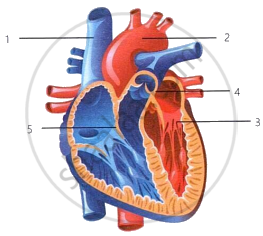
- Name the phase.
- Which part of the heart is contracting in this phase? Give a reason to support your answer.
- Name the parts labelled 1 to 4.
- What type of blood flows through 2?
- State the function of the part numbered ‘5’.
- Name the membrane that covers the heart.
The diagram given below represents a section of the human heart. Answer the questions that follow:
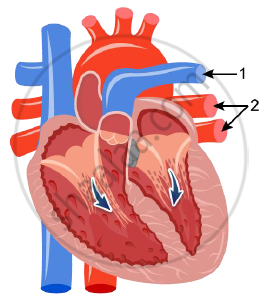
- Which parts of heart are in the diastolic phase? Give a reason to support your answer.
- Label the parts numbered 1 and 2 in the diagram. What type of blood flows through them?
- What causes the heart sounds ‘LUBB’ and ‘DUP’?
- Name the blood vessels that supply oxygenated blood to the heart muscles.
- Draw neat labelled diagrams of a cross section of an artery and a vein.
Given along is a diagram of a human blood smear. Study the diagram and answer the questions that follow:
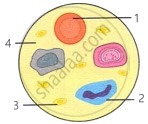
- Name the components numbered ‘1’ to ‘4’.
- Mention two structural differences between the parts ‘1’ and ‘2’.
- Name the soluble protein found in part ‘4’ which forms insoluble threads during clotting of blood.
- What is the average life span of the component numbered ‘1’?
- Component numbered ‘1’ do not have certain organelles but are very efficient in their function. Explain.
Name the mineral elements required for the clotting of blood.
Name the mineral element required for the synthesis of thyroxine.
Describe the structural differences between an artery and a vein.
Define the following term:
Diapedesis
What are the functions of blood?
State the exact location of the following structure.
Papillary muscles
Give the exact location of the pericardium.
The exact location of the Bicuspid value
The diagram below depicts the human heart in one of its phases. Answer the questions that follow:

- Which part of the heart is in the contraction phase?
- Give a suitable reason to justify your answer in (a).
- Distinguish between Systole and Diastole.
The diagram given below represents the simplified pathway of the circulation of blood. Answer the questions that follow.
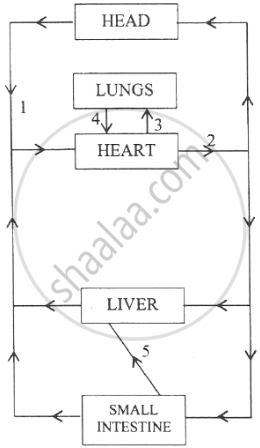
- Name the blood vessels labelled 1 to 4.
- Which blood vessel supplies oxygenated blood to the muscles of the heart?
- What is the importance of blood vessel labelled 5?
- What is the type of blood circulation that takes place between the heart and the lungs?
- Draw a diagram of the different blood cells as seen in a smear of human blood.
Why are RBCs efficient in their functions though they lack nucleus and mitochondria?
Differentiate between afferent arteriole and efferent arteriole. (diameter)
Solutions for 8: Circulatory System
Frank solutions for बायोलॉजी पार्ट २ [इंग्रजी] इयत्ता १० आयएससी chapter 8 - Circulatory System
Shaalaa.com has the CISCE Mathematics बायोलॉजी पार्ट २ [इंग्रजी] इयत्ता १० आयएससी CISCE solutions in a manner that help students grasp basic concepts better and faster. The detailed, step-by-step solutions will help you understand the concepts better and clarify any confusion. Frank solutions for Mathematics बायोलॉजी पार्ट २ [इंग्रजी] इयत्ता १० आयएससी CISCE 8 (Circulatory System) include all questions with answers and detailed explanations. This will clear students' doubts about questions and improve their application skills while preparing for board exams.
Further, we at Shaalaa.com provide such solutions so students can prepare for written exams. Frank textbook solutions can be a core help for self-study and provide excellent self-help guidance for students.
Concepts covered in बायोलॉजी पार्ट २ [इंग्रजी] इयत्ता १० आयएससी chapter 8 Circulatory System are Blood Circulatory System, Circulation of Blood in the Heart (Functioning of Heart), Fluids in Our Body, Blood, Functions of Blood, Plasma (The Liquid Portion of Blood), Pacemaker, Need for Transport in the Body, Blood Vessels Entering and Leaving The Heart, Valves of the Heart, Heart Beat, Arteries Vs Veins, Pulmonary and Systemic Circulation (Double Circulation), Hepatic Portal System, The Pulse, Tissue Fluid (Or Intercellular Fluid), The Spleen, Erythrocytes vs Leukocytes vs Thrombocytes – A Comparative Overview, Blood Circulatory System, Circulation of Blood in the Heart (Functioning of Heart), Fluids in Our Body, Blood, Functions of Blood, Plasma (The Liquid Portion of Blood), Pacemaker, Need for Transport in the Body, Blood Vessels Entering and Leaving The Heart, Valves of the Heart, Heart Beat, Arteries Vs Veins, Pulmonary and Systemic Circulation (Double Circulation), Hepatic Portal System, The Pulse, Tissue Fluid (Or Intercellular Fluid), The Spleen, Erythrocytes vs Leukocytes vs Thrombocytes – A Comparative Overview.
Using Frank बायोलॉजी पार्ट २ [इंग्रजी] इयत्ता १० आयएससी solutions Circulatory System exercise by students is an easy way to prepare for the exams, as they involve solutions arranged chapter-wise and also page-wise. The questions involved in Frank Solutions are essential questions that can be asked in the final exam. Maximum CISCE बायोलॉजी पार्ट २ [इंग्रजी] इयत्ता १० आयएससी students prefer Frank Textbook Solutions to score more in exams.
Get the free view of Chapter 8, Circulatory System बायोलॉजी पार्ट २ [इंग्रजी] इयत्ता १० आयएससी additional questions for Mathematics बायोलॉजी पार्ट २ [इंग्रजी] इयत्ता १० आयएससी CISCE, and you can use Shaalaa.com to keep it handy for your exam preparation.
