Advertisements
Advertisements
Question
The diagram below shows three ways in which the string of an instrument can vibrate.

(i) Which of the above diagrams shows the fundamental note?
(ii) Which has the frequency 4 times that of the fundamental?
(iii) State the ratio between the frequency of the first and second.
Advertisements
Solution
(i) The diagram (i) represents the fundamental note because its frequency is lowest and amplitude maximum.
(ii) The diagram: (ii) represents the sound note having frequency four times that of the (i) or fundamental.
(iii) The frequency: (ii) is two times the frequency of (i) so the ratio between the frequencies of (i) and (ii) is 1: 2.
RELATED QUESTIONS
Name the factor that determines Loudness of the sound heard.
Match the following
| column A | column B |
| (A) Amplitude | (1) frequency |
| (B) Frequency | (2) amplitude |
| (C) Loudness | (3)maximum displacement on either side |
| (D) Pitch | (4) presence of other frequencies |
| (E) Waveform | (5) 1/ time period |
Define the following term:
Frequency
State three factors on which loudness of sound heard by a listener depends.
Name and define the characteristic which enables one to distinguish two sounds of same loudness, but of different frequencies, given by the same instrument.
Two identical guitars are played by two persons to give notes of the same loudness and pitch. Will they differ in quality? Give reason for your answer.
Two musical notes of the same pitch and same loudness are played on two different instruments. Their wave patterns are as shown in figure.
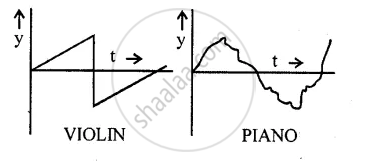
How do they differ in
(a) loudness,
(b) pitch and
(c) quality
Name the unit in which loudness of sound is measured.
What does the intensity of sound depend upon?
What is acoustics?
