Advertisements
Advertisements
Question
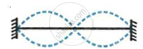
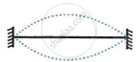
The diagram below shows three different modes of vibration P, Q and R of the same string of a given length.
 |
 |
 |
| P | Q | R |
- Which vibration will produce a louder sound and why?
- Which vibration will produce sound of maximum shrillness (or pitch) and why?
- What is the ratio of wavelength of vibrations P and R?
Advertisements
Solution
(a) R will produce maximum sound because it has maximum amplitude.
(b) P will produce maximum shrillness because it has a maximum frequency.
(c) Let's suppose the string has length l
Then wavelength of P = `"2 l"/3`
Wavelength of R = 2 l
∴ `lambda_"P"/lambda_"R" = ("2 l"/3)/"2 l" = 1/3`
∴ λp : λR = 1 : 3
APPEARS IN
RELATED QUESTIONS
The adjacent diagram shows three different modes of vibrations P, Q and R of the same string.
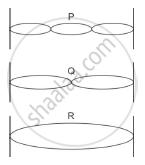
(i) Which vibration will produce a louder sound and why?
(ii) The sound of which string will have maximum shrillness?
(iii) State the ratio of wavelengths of P and R.
Distinguish between the free (or natural) and forced vibrations.
When a body vibrates under a periodic force, the vibrations of the body are ______.
Give two examples of forced vibrations.
What do you mean by resonance? When does resonance occur?
Explain why does the rear mirror of a motorbike start Vibrating Violently, at some particular speed of motorbike?
What do you understand by forced vibrations?
What are the factors that affect the frequency of a vibrating string and how do they affect the frequency?
