Advertisements
Advertisements
Question
The diagonal of a rectangle is 34 cm. If its breadth is 16 cm; find its :
(i) length
(ii) area
Advertisements
Solution
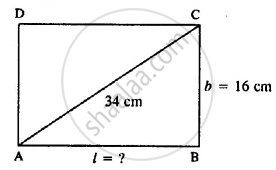
AC2 = AB2+BC2 (By Pythagoras theorem)
(34)2 = l2 + (16)2
1156 = l2 + 256
l2 = 1156 – 256
l2 = 900
l = `sqrt(900)` = 30 cm
area = l x b = 30 x 16 = 480 cm2
(i) 30 cm (ii) 480 cm2
APPEARS IN
RELATED QUESTIONS
Find the length and perimeter of a rectangle, whose area = 120 cm2 and breadth = 8 cm
Find the perimeter of a rectangle whose:
length = 40 cm and breadth = 35 cm
Find the perimeter of a rectangle whose:
length = 10 m and breadth = 8 m
Find the perimeter of a rectangle whose:
length = 8 m and breadth = 80 cm
An equilateral triangle and d square has equal perimeter. If side of the triangle is 9.6 cm ; what is the length of the side of the square?
If A denotes area of a rectangle, l represents its length and b represents its breadth, find:
b, if A = 88 m² and l = 8m
The perimeter of a square plot = 360 m. Find:
- its area.
- cost of fencing its boundary at the rate of ₹ 40 per meter.
- cost of levelling the plot at ₹60 per square meter.
If every side of a rectangle is doubled, then its area becomes _______ times
How many different rectangles can be made with a 48 cm long string? Find the possible pairs of length and breadth of the rectangles.
36 unit squares are joined to form a rectangle with the least perimeter. Perimeter of the rectangle is ______.
