Advertisements
Advertisements
Question
The component of a vector r along X-axis will have maximum value if ______.
Options
r is along positive Y-axis
r is along positive X-axis
r makes an angle of 45° with the X-axis
r is along negative Y-axis
Advertisements
Solution
The component of a vector r along X-axis will have maximum value if r is along positive X-axis.
Explanation:
Consider a vector `vecR` in X - Y plane as shown in the figure. If we draw orthogonal vectors `vecR_x` and `vecR_y` along x and y axes respectively, by law of vector addition, `vecR = vecR_x + vecR_y`
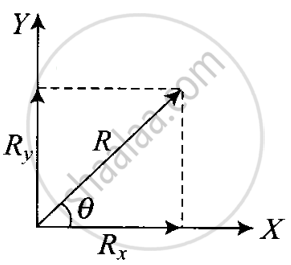
The magnitude of component of r along the X-axis
`r_x = |r| cos theta`
`(r_x)_"maximum" = |r| (cos theta)_"maximum"`
`r_x = |r| cos theta`
= `|r| cos 0°`
= `|r|` .....(∵ cos θ is maximum if θ = 0°)
As θ = 0°,
r is along the positive x-axis.
APPEARS IN
RELATED QUESTIONS
`hati "and" hatj` are unit vectors along x- and y-axis respectively. What is the magnitude and direction of the vectors `hati+hatj` and `hati-hatj` ? What are the components of a vector `A = 2hati + 3hatj` along the directions of `hati + hatj` and `hati - hatj` ? [You may use graphical method]
For `vec v_1 = 2 hat i - 3 hat j` and `vec v_2 = -6hat i + 5 hat j`, determine the magnitude and direction of `vec v_1 + vec v_2`.
Find a vector which is parallel to `vec"v" = hat"i" - 2hat"j"` and has a magnitude 10.
Show that vectors `vec a = 2 hat i + 5 hat j - 6 hat k` and `vec b = hat i + 5/2 hat j - 3 hat k` are parallel.
Determine `veca xx vecb`, given `veca = 2hati + 3hatj and vecb = 3hati + 5hatj`.
Walking of a person on the road is an example of
Figure shows the orientation of two vectors u and v in the XY plane.
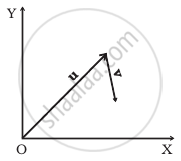
If `u = ahati + bhatj` and `v = phati + qhatj`
which of the following is correct?
What is the process of splitting a single vector into two or more vectors along specific directions called?
What is the defining feature of rectangular components of a vector?
A vector \[\vec V\] = 3î + 4ĵ. What is the magnitude of this vector?
Which of the following correctly represents a vector in a 3D coordinate system using unit vectors?
The component of a vector may be ______.
The vector projection of a vector 3\[\hat i\] + 4\[\hat k\] on Y-axis is ______.
A vector is represented by 3\[\hat i\] + \[\hat j\] + 2\[\hat k\]. Its length in XY plane is ______.
A particle is simultaneously acted by two forces equal to 4 N and 3 N. The net force on the particle is ______.
