Advertisements
Advertisements
Question
Figure shows the orientation of two vectors u and v in the XY plane.
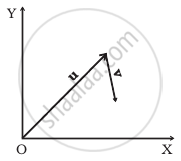
If `u = ahati + bhatj` and `v = phati + qhatj`
which of the following is correct?
Options
a and p are positive while b and q are negative.
a, p and b are positive while q is negative.
a, q and b are positive while p is negative.
a, b, p and q are all positive.
Advertisements
Solution
a, p and b are positive while q is negative.
Explanation:
Resolution of Vector into Components: Consider a vector `vecR` in X - Y plane as shown in the figure. If we draw orthogonal vectors `vecR_x` and `vecR_y` along x and y axes respectively, by the law of vector; addition, `vecR = vecR_x + vecR_y`
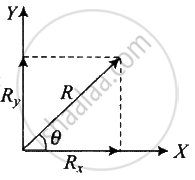
Now as for any vector `vecA = Ahatn, hatn` is the direction of `vecA` so
`vecR_x = hatiR_x` and `vecR_y = hatjR_y`
Thus, `vecR = hatiR_x + hatjR_y` .....(i)
But from figure, `R_x = R cos theta` ......(ii)
And `R_y = R sin theta` ......(iii)
Since R and θ are usually known, equations (ii) and (iii) give the magnitude of the components of `vecR` along x- and y-axes respectively.
Here it is worth to note once a vector is resolved into its components, the components themselves can be used to specify the vector as:
(1) The magnitude of the vector `vecR` is obtained by squaring and adding equations (ii) and (iii), i.e.
`R = sqrt(R_x^2 + R_y^2)`
(2) The direction of the vector `vecR` is obtained by dividing equation (iii) by (ii), ie.
`tan theta = (R_y/R_x)` or `theta = tan^-1 (R_y/R_x)`
In such type of problems, we have to resolve the rectangular components according to the diagram.
Clearly from the diagram `vecu = ahati + bhatj`.
As u is in the first quadrant, hence both of its components a and b will be positive and as v is in the fourth quadrant. For `vecv = phati + qhatj`, as it is in positive x-direction and located downward hence x-component p will be positive and y-component q will be negative.

APPEARS IN
RELATED QUESTIONS
`hati "and" hatj` are unit vectors along x- and y-axis respectively. What is the magnitude and direction of the vectors `hati+hatj` and `hati-hatj` ? What are the components of a vector `A = 2hati + 3hatj` along the directions of `hati + hatj` and `hati - hatj` ? [You may use graphical method]
For `vec v_1 = 2 hat i - 3 hat j` and `vec v_2 = -6hat i + 5 hat j`, determine the magnitude and direction of `vec v_1 + vec v_2`.
Find a vector which is parallel to `vec"v" = hat"i" - 2hat"j"` and has a magnitude 10.
Show that vectors `vec a = 2 hat i + 5 hat j - 6 hat k` and `vec b = hat i + 5/2 hat j - 3 hat k` are parallel.
Walking of a person on the road is an example of
What is the process of splitting a single vector into two or more vectors along specific directions called?
A vector \[\vec V\] = 3î + 4ĵ. What is the magnitude of this vector?
Which of the following correctly represents a vector in a 3D coordinate system using unit vectors?
What is the result of dividing a non-zero vector \[\vec V\] by its own magnitude ∣\[\vec V\]∣?
The unit vector parallel to the resultant of the vectors \[\vec A\] = 4\[\hat i\] + 3\[\hat j\] + 6\[\hat k\] and \[\vec B\] = -\[\hat i\] + 3\[\hat j\] - 8\[\hat k\] is ______.
The component of a vector may be ______.
The vector projection of a vector 3\[\hat i\] + 4\[\hat k\] on Y-axis is ______.
A vector is represented by 3\[\hat i\] + \[\hat j\] + 2\[\hat k\]. Its length in XY plane is ______.
A particle is simultaneously acted by two forces equal to 4 N and 3 N. The net force on the particle is ______.
