Advertisements
Advertisements
Question
The circulatory system of the fetus and that of the mother are never connected directly. What are the advantages?
Advertisements
Solution
The separate circulatory system facilitates quick diffusion of nutrients, metabolic waste and respiratory gases between the foetus and the mother. Bacteria and other pathogens cannot pass from the mother to the foetus because they are filtered out by the placenta. Blood pressure changes in the maternal circulation also cannot affect the foetus which has delicate blood vessels.
APPEARS IN
RELATED QUESTIONS
Name the following:
The membrane which protects the foetus and encloses a fluid
Give appropriate terms for the following:
Rupture of follicle and release of ovum from the ovary.
State whether the following statements are TRUE (T) or FALSE (F):
Rewrite the wrong statement by correcting only one word either at the beginning or at the end of the sentence.
Nutrition and oxygen diffuse from the mother’s blood into the foetus’s blood through amnion.
Given below are the names of certain stages/substances related to reproduction and found in human body. Answer the questions related to them.
Gestation
• What is its meaning?
• How long does it normally last?
Differentiate between:
Impotency and sterility
Differentiate between:
Amnion and allantois
Name and describe very briefly, the stages in the development of human embryo.
The diagram given below is that of a developing human foetus in the womb. Study the same and then answer the questions that follow:
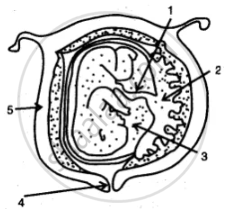
- Name the parts '1' to '5' indicated by guidelines.
- What term is given to the period of development of the foetus in the womb?
- How many days does the foetus take to be fully developed?
- Mention two functions of the parts labelled ‘2’ other than its endocrine function.
- Name the hormone (anyone) produced by the part labelled ‘2’.
- What is the function of the part marked ‘3’?
Match the respiratory surfaces to the organisms in which they are found.
| Organ/ cells | Hormones | ||
| (i) | Corpus luteum | (a) | HCG |
| (ii) | Leydig's cells | (b) | Estrogen |
| (iii) | Placenta | (c) | Progesterone |
| (iv) | Graafian follicle | (d) | Testosterone |
Assertion (A): The foetus respires but does not breathe.
Reason (R): The maternal blood supplies oxygen to the foetus through placenta.
