Advertisements
Advertisements
Question
The calorie is defined as 1 cal = 4.186 joule. Why not as 1 cal = 4 J to make the conversions easy?
Advertisements
Solution
One calorie is defined as the heat required to raise the temperature of 1 g of water from 14.5o C to 15.5o C. Also, exactly 4.186 J of work is to be done on heating 1 g of water from 14.5o C to 15.5o C. So, we cannot round-off 4.186 J to 4 J as it will give significant difference in work done required to raise the temperature and heat required to raise the temperature.
Since work and heat are equivalent here, so on taking 1 calorie = 4 J, the validity of the equivalence of work and heat will get defied. Thus, just to make conversion easy, 1 calorie cannot be taken equal to 4 J.
APPEARS IN
RELATED QUESTIONS
A calorimeter is kept in a wooden box to insulate it thermally from the surroundings. Why is it necessary?
Refer to the plot of temperature versus time (figure) showing the changes in the state of ice on heating (not to scale).
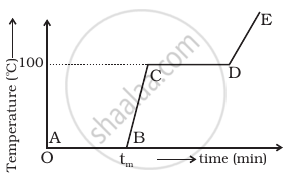
- The region AB represents ice and water in thermal equilibrium.
- At B water starts boiling.
- At C all the water gets converted into steam.
- C to D represents water and steam in equilibrium at boiling point.
A copper block of mass 2.5 kg is heated in a furnace to a temperature of 500°C and then placed on large ice block. The maximum amount of ice that can melt is ______.
(Specific heat of copper = 0.39 Jg-1 c-1, latent heat of 0 fusion of water = 335 Jg-1)
80 gm of water at 30°C is poured on a large block of ice at 0°C. The mass of ice that melts is ______.
Work done in converting one gram of ice at -10°C into steam at 100°C is ______.
The specific heat of a substance is given by C = a + bT, where a = 1.12 kJ kg-1K-1 and b = 0.016 kJ-kg K-2. The amount of heat required to raise the temperature of 1.2 kg of the material from 280 K to 312 K is ______.
500 g of water and 100 g of ice at 0°C are in a calorimeter whose water equivalent is 40 g. 10 g of steam at 100°C is added to it. Then water in the calorimeter is ______.
(Latent heat of ice = 80 cal/g, Latent heat of steam = 540 cal/g)
540 g of ice at 0°C is mixed with 540 g of water at 80°C. The final temperature of the mixture will be ______.
What does the word "calorimetry" mean?
The principle of calorimetry is based on which law?
What is the purpose of the outer jacket and air gap in a calorimeter?
In the method of mixtures, why should the hot sample be transferred quickly into the calorimeter?
What is the role of the stirrer in a calorimetry experiment?
The specific heat capacity of water is approximately ______.
Why is water commonly used as the liquid in a calorimeter?
In a calorimetry experiment, the numerator of the specific heat formula (m2s2 + m3s3)(T − T2) represents ______.
