Advertisements
Advertisements
Question
Refer to the plot of temperature versus time (figure) showing the changes in the state of ice on heating (not to scale).
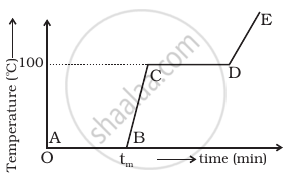
- The region AB represents ice and water in thermal equilibrium.
- At B water starts boiling.
- At C all the water gets converted into steam.
- C to D represents water and steam in equilibrium at boiling point.
Advertisements
Solution
a and d
Explanation:
During the process AB temperature of the system is 0°C Hence, it represents phase change that is the transformation of ice into water while the temperature remains 0°C.
BC represents a rise in the temperature of water from 0°C to 100°C (at C).
Now, water starts converting into steam which is represented by CD.
APPEARS IN
RELATED QUESTIONS
The calorie is defined as 1 cal = 4.186 joule. Why not as 1 cal = 4 J to make the conversions easy?
A calorimeter is kept in a wooden box to insulate it thermally from the surroundings. Why is it necessary?
Three bodies of the same material and having masses of m, m and 3m are at temperatures of 40°C, 50°C and 60°C respectively. If the bodies are brought in thermal contact, the final temperature will be:
On an X temperature scale, water freezes at -125°X and boils at 375°X. On a Y temperature scale, water freezes at -70°Y and boils at -30°Y. The value of temperature on X scale is ______ on which value of temperature on y Scale becomes 50° Y.
80 gm of water at 30°C is poured on a large block of ice at 0°C. The mass of ice that melts is ______.
The specific heat of a substance is given by C = a + bT, where a = 1.12 kJ kg-1K-1 and b = 0.016 kJ-kg K-2. The amount of heat required to raise the temperature of 1.2 kg of the material from 280 K to 312 K is ______.
500 g of water and 100 g of ice at 0°C are in a calorimeter whose water equivalent is 40 g. 10 g of steam at 100°C is added to it. Then water in the calorimeter is ______.
(Latent heat of ice = 80 cal/g, Latent heat of steam = 540 cal/g)
540 g of ice at 0°C is mixed with 540 g of water at 80°C. The final temperature of the mixture will be ______.
What does the word "calorimetry" mean?
Why is the inner vessel of a calorimeter made of copper?
The principle of calorimetry is based on which law?
What is the purpose of the outer jacket and air gap in a calorimeter?
The specific heat capacity of water is approximately ______.
Why is water commonly used as the liquid in a calorimeter?
A calorimeter is designed to act like a thermos flask. Which feature of the calorimeter is primarily responsible for this thermal isolation?
