Advertisements
Advertisements
Question
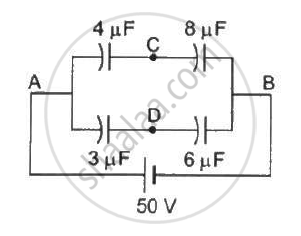
Take the potential of the point B in figure to be zero. (a) Find the potentials at the points C and D. (b) If a capacitor is connected between C and D, what charge will appear on this capacitor?
Advertisements
Solution
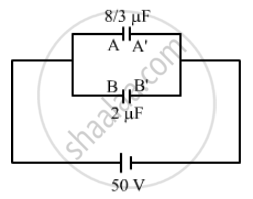
(a) The capacitance of the two rows connected in parallel is given by
`C_1 = (4 xx 8)/(4+8) = 8/3 "uF" and C_2 = (3 xx 6)/(3+6) = 18/9 "uF" = 2 "uF"`
As the two rows are in parallel, the potential difference across each row is the same and is equal to 50 V.
The charge on the branch ACB with capacitance `8/3 "uF"` is given by
`Q = (8/3 "uF") xx (50 V) = 400/3 "uC"`
The charge on the branch ADB with capacitance `2 "uF"` is given by
`Q = C xx V`
`Q = 2 "uF" xx 50 = 100 "uC"`
The potential at point D is given by
`V_D = q/C_1 = (100 "uC")/(6 "uF")`
`V_D = 50/3 V`
Similarly, the potential at point C is given by
`V_c = 50/3 V`
(b) As the potential difference between points C and D is zero, the bridge remains balanced and no charge flows from C to D. If a capacitor is connected between points C and D, then the change on the capacitor will be zero.
