मराठी
कर्नाटक बोर्ड पी.यू.सी.पीयूसी विज्ञान इयत्ता ११

Take the Potential of the Point B in Figure to Be Zero. (A) Find the Potentials at the Points C and D. (B) If a Capacitor is Connected Between C and D, What Charge Will Appear on this Capacitor? - Physics

Advertisements
Advertisements

प्रश्न

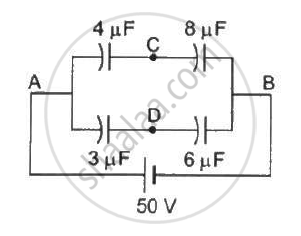
Take the potential of the point B in figure to be zero. (a) Find the potentials at the points C and D. (b) If a capacitor is connected between C and D, what charge will appear on this capacitor?
बेरीज
Advertisements

उत्तर

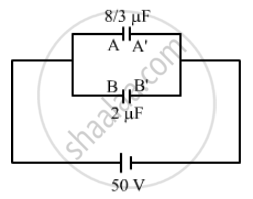
(a) The capacitance of the two rows connected in parallel is given by

`C_1 = (4 xx 8)/(4+8) = 8/3  "uF" and C_2 = (3 xx 6)/(3+6) = 18/9 "uF" = 2  "uF"`

As the two rows are in parallel, the potential difference across each row is the same and is equal to 50 V.

The charge on the branch ACB with capacitance `8/3 "uF"` is given by

`Q = (8/3  "uF") xx (50 V) = 400/3 "uC"`

The charge on the branch ADB with capacitance `2  "uF"` is given by

`Q = C xx V`

`Q = 2  "uF" xx 50 = 100  "uC"`

The potential at point D is given by

`V_D = q/C_1 = (100  "uC")/(6  "uF")`

`V_D = 50/3 V`

Similarly, the potential at point C is given by

`V_c = 50/3 V`


(b) As the potential difference between points C and D is zero, the bridge remains balanced and no charge flows from C to D. If a capacitor is connected between points C and D, then the change on the capacitor will be zero.

shaalaa.com
  या प्रश्नात किंवा उत्तरात काही त्रुटी आहे का?
पाठ 9: Capacitors - Exercises [पृष्ठ १६६]

APPEARS IN

एचसी वर्मा Concepts of Physics Vol. 2 [English] Class 11 and 12
पाठ 9 Capacitors
Exercises | Q 15 | पृष्ठ १६६

संबंधित प्रश्‍न

The particle P shown in figure has a mass of 10 mg and a charge of −0⋅01 µC. Each plate has a surface area 100 cm2 on one side. What potential difference V should be applied to the combination to hold the particle P in equilibrium?


Show that electric potential at a point P, at a distance 'r' from a fixed point charge Q, is given by:
    `v=(1/(4pi∈_0))Q/r`.


The magnitude of the electric field (in NC – 1) in a region varies with the distance r(in m) as

E = 10 r + 5

By how much does the electric potential increase in moving from point at r = 1 m to a point at r = 10 m.


Electric potential energy of two point charges q and q0 is ________.


If a positive charge moves opposite to the direction of the electric field, the field does _______ work on charge and potential energy ________.


It becomes possible to define potential at a point in an electric field because electric field ______.


A cube of metal is given a positive charge Q. For this system, which of the following statements is true?


From a point charge, there is a fixed point A. At A, there is an electric field of 500 V/m and potential difference of 3000 V. Distance between point charge and A will be ______.


A positively charged particle is released from rest in a uniform electric field. The electric potential energy of the charge ______.


A test charge is moved from lower potential point to a higher potential point. The potential energy of test charge will ______.


If a conductor has a potential V ≠ 0 and there are no charges anywhere else outside, then ______.


The force acting on a particle in one dimension is F = ax - 2xβ3. The corresponding potential energy V(x), assuming V(0) = 0 is given by ______.


If a conductor has a potential V ≠ 0 and there are no charges anywhere else outside, then ______.

  1. there must be charges on the surface or inside itself.
  2. there cannot be any charge in the body of the conductor.
  3. there must be charges only on the surface.
  4. there must be charges inside the surface.

The electric potential on the axis of an electric dipole at a distance ‘r from it’s centre is V. Then the potential at a point at the same distance on its equatorial line will be ______.


Share
Notifications

Englishहिंदीमराठी


      Forgot password?
Use app×