Take an open flask and boil some water in it. Insert a tight cork along with a thermometer inside the flask. Now invert the flask and pour some cold water over it.
Advertisements
Question
Take an open flask and boil some water in it. Insert a tight cork along with a thermometer inside the flask. Now invert the flask and pour some cold water over it. It will prevent the steam pressure from forcing the cork out. The temperature of the air above water in the flask falls, but the boiling continues. Now cool the flask to about \[65^{\circ}\text{C}\]. What do you notice? The process of boiling stops. Again, pour some cold water on the flask. As the temperature falls further, the boiling begins again. It demonstrates that boiling of water can be carried out even at a temperature below its normal boiling point. Thus, we can boil water even by cooling it.
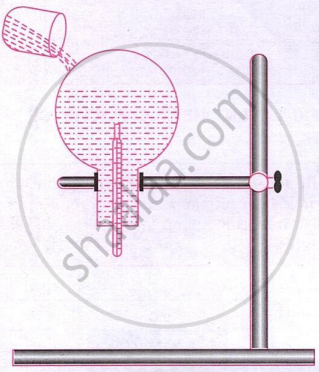
Boiling of water by cooling.
Advertisements
Solution
Aim: To demonstrate that water can boil at a temperature below its normal boiling point by reducing the pressure above its surface.
Observation: When cold water is poured over the inverted flask, the steam inside condenses, reducing the pressure. Boiling continues for some time but stops when the temperature reaches about 65°C. On pouring cold water again, boiling starts once more, even at a lower temperature.
