Take some crushed ice in a beaker. Insert a thermometer to note its temperature. It should be 0∘C. Heat the ice-water (Fig.). Note the temperature change every one minute, if any,
Advertisements
Question
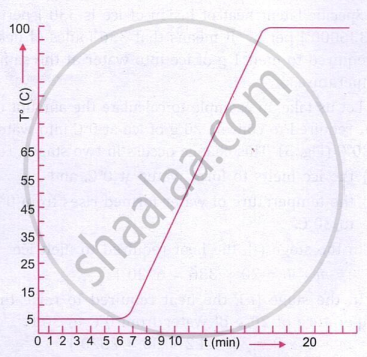
Take some crushed ice in a beaker. Insert a thermometer to note its temperature. It should be \[0^{\circ}\text{C}\]. Heat the ice-water (Fig.). Note the temperature change every one minute, if any, till it starts boiling. (Keep stirring the ice-water mixture constantly, so that the temperature is uniform throughout). Record your temperature-time observations in a tabular form and plot a graph between the two.
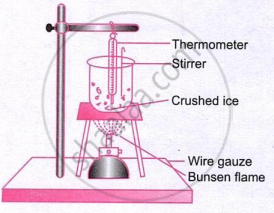
Boiling temperature.
| Time | Temperature of ice on heating |
|---|---|
| 0 min. | 0°C |
| 1 min. | 0°C |
| 5 min. | 0°C |
| 6 min | 0°C |
| 7 min. | 5°C |
| 10 min. | 15°C |
| 16 min. | 95°C |
| 17 min. | 100°C |
| 20 min. | 100°C |
Advertisements
Solution
Aim: To study how the temperature of ice-water changes with time during heating and to observe the melting point of ice and the boiling point of water.
Observation: When crushed ice-water is heated using a Bunsen burner at a constant rate and stirred continuously:
- The temperature remains constant at \[0^{\circ}\text{C}\] from \[0\ \text{min}] to [6\ \text{min}\], while the ice changes into water.
- After all the ice has melted, the temperature of the water rises from \[0^{\circ}\text{C}\] to \[5^{\circ}\text{C}\] at \[7\ \text{min}\], \[15^{\circ}\text{C}\] at \[10\ \text{min}\], and \[95^{\circ}\text{C}\] at \[16\ \text{min}\].
- The temperature remains constant at \[100^{\circ}\text{C}\] from \[17\ \text{min}\] to \[20\ \text{min}\], while the water changes into steam.
Conclusion: During a change of state, the temperature remains constant even though heat is continuously supplied. The supplied heat is used as latent heat to overcome intermolecular forces rather than increase the temperature.
The heat required for a change of state is given by:
\[{Q = mL}\]
where:
- Q = heat energy supplied \[(\text{J})\]
- m = mass of the substance undergoing change of state \[(\text{kg})\]
- L = specific latent heat of fusion or specific latent heat of vaporization \[(\text{J kg}^{-1})\]
Thus, the melting point of ice is 0°C, and the boiling point of water is 100°C at normal atmospheric pressure.
