Advertisements
Advertisements
Question
Suppose You Are Given a Circle. Give a Construction to Find Its Centre.
Advertisements
Solution
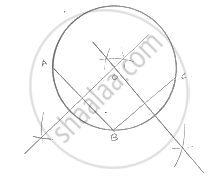
Steps of constructions:
(1) Take three point A, B and C the given circle
(2) Join AB and BC
(3) Draw the perpendicular bisectors of chord AB and BC which intersect each other at O.
(4) Point O will be the required center of the circle because we know that the perpendicular
bisector of the cord always passes through the center
APPEARS IN
RELATED QUESTIONS
Prove that the tangents at the extremities of any chord make equal angles with the chord.
true or false
Sector is the region between the chord and its corresponding arc.
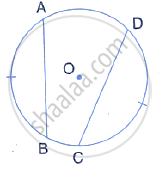
In the given figure, if arc AB = arc CD, then prove that the quadrilateral ABCD is an isosceles– trapezium (O is the centre of the circle).
A quadrilateral is drawn to circumscribe a circle. Prove that the sums of opposite sides are equal.
In Fig. 4, a circle inscribed in triangle ABC touches its sides AB, BC and AC at points D, E and F respectively. If AB = 12 cm, BC = 8 cm and AC = 10 cm, then find the lengths of AD, BE and CF.

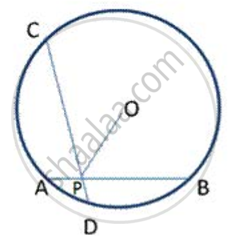
AB and CD are two equal chords of a drde intersecting at Pas shown in fig. P is joined to O , the centre of the cirde. Prove that OP bisects ∠ CPB.
Two concentric circles with center O have A, B, C, D as the points of intersection with the lines L shown in the figure. If AD = 12 cm and BC s = 8 cm, find the lengths of AB, CD, AC and BD.
Draw circle with diameter: 8.4 cm
In above case, measure the length of the radius of the circle drawn.
In a right triangle ABC in which ∠B = 90°, a circle is drawn with AB as diameter intersecting the hypotenuse AC and P. Prove that the tangent to the circle at P bisects BC.
Find the length of the arc of a circle which subtends an angle of 60° at the centre of the circle of radius 42 cm.
