Advertisements
Advertisements
Question
AB and AC are two equal chords of a circle. Prove that the bisector of the angle BAC passes through the centre of the circle.
Advertisements
Solution
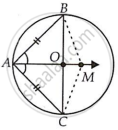
Given: We have a circle whose centre is O and chords AB and AC are equal. AM is the bisector of ∠BAC.
To prove: Centre O lies on the bisector of ∠BAC.
Construction: Join BM and CM.
Proof: In ΔBAM and ΔCAM,
AB = AC ...[Given]
∠BAM = ∠CAM ...[Given]
AM = AM ...[Common]
∴ ΔBAM ≅ ΔCAM ...[By SAS congruency]
`\implies` BM = CM [By C.P.C.T.] ...(i)
And ∠BMA = ∠CMA [By C.P.C.T.] ...(ii)
In ΔBOM and ΔCOM,
BM = CM ...[By (i)]
OM = OM ...[Common]
∠BMO = ∠CMO ...[By (ii)]
∴ ΔBOM and ΔCOM ...[By SAS congruency]
`\implies` ∠BOM = ∠COM [By C.P.C.T.] ...(iii)
Since, ∠BOM + ∠COM = 180° ...(iv)
∴ By (iii) and (iv), ∠BOM = ∠COM = 90°
So, AM is the perpendicular bisector of the chord BC.
Thus, bisector of ∠BAC i.e., AM passes through the centre O.
APPEARS IN
RELATED QUESTIONS
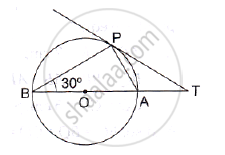
In the given figure, O is the centre of the circle and TP is the tangent to the circle from an external point T. If ∠ PBT = 30°, prove that BA : AT = 2 : 1.
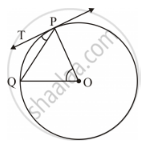
In figure 1, O is the centre of a circle, PQ is a chord and PT is the tangent at P.
If ∠POQ = 70°, then ∠TPQ is equal to
In a cyclic quadrilateral ABCD if AB || CD and ∠B = 70°, find the remaining angles.
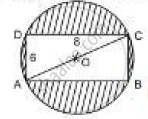
Find the area of the shaded region in the figure If ABCD is a rectangle with sides 8 cm and 6 cm and O is the centre of the circle. (Take π= 3.14)
Can the length of a chord of a circle be greater than its diameter ? Explain.
State, if the following statement is true or false:
If the end points A and B of the line segment lie on the circumference of a circle, AB is a diameter.
Two circles with centres O and O' of radii 3 cm and 4 cm, respectively intersect at two points P and Q such that OP and O'P are tangents to the two circles. Find the length of the common chord PQ.
In the following figure, if AOB is a diameter of the circle and AC = BC, then ∠CAB is equal to ______.

If a line segment joining mid-points of two chords of a circle passes through the centre of the circle, prove that the two chords are parallel.
A 7 m broad pathway goes around a circular park with a circumference of 352 m. Find the area of road.
