Advertisements
Advertisements
Question
Study the following phrases and their meanings. Use them appropriately to complete the sentences that follow.
I promise to ………….. on your brother when I visit Lucknow next.
Options
look after: take care of
look down on: disapprove or regard as inferior
look in (on someone): make a short visit
look into: investigate
look out: be careful
look up: improve
look up to: admire
Advertisements
Solution
I promise to look in on your brother when I visit Lucknow next.
RELATED QUESTIONS
Answer these question in a few words or a couple of sentence.
How old was Evelyn when she went to the Royal Academy of Music?
Can you think of any scientists, who have also been statesmen?
Sergei says, “I am happy that my words have taken effect.” Why does he say so? Is he right in saying this?
Now, it is your turn. Write and produce your own radio programme. You will need to select your own content. The following are some ideas. You are free, of course, to add your own ideas. Remember, the programme must be in English.
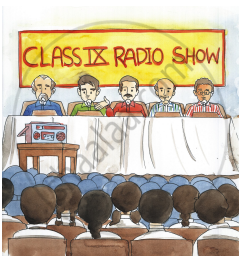
- News stories: about people in your class, about school, about sports (school and local), about the local community
- Comedy: jokes, short plays
- Interviews: with teachers, with exstudents of your school, with a Class IX student who has recently done something very interesting
- Games: general knowledge quiz, panel game, word game
- Advertisements: for shops/industries in the local community, things ‘for sale’ and ‘wanted’ by students
- Local sites: monuments/sites of historical importance and of tourist interest
- Special reports: e.g. safety at school, examination results, school uniform, school assemblies
- Interesting people: role-play interviews with film stars, sports personalities, TV personalities, etc.
- Entertainment reviews: music, films, videos, books, etc.
- Plays
- Songs with lyrics
- Speeches on important personalities
- Tele conference video conference with students, teachers, experts
What does he plant who plants a tree?
He plants, in sap and leaf and wood,
In love of home and loyalty
And far-cast thought of civic good____
His blessing on the neighbourhood,
Who in the hollow of his hand
Holds all the growth of all our land____
A nation's growth from sea to sea
Stirs in his heart who plants a tree.
Read the lines given above and answer the question that follow:
Does the man plant a tree because of his love of society and his nation?
Six humans trapped by happenstance
In black and bitter cold.
Each one possessed a stick of wood,
Or so the story's told.
Their dying fire in need of logs;
The first man held his back.
For on the faces around the fire,
He noticed one was black.
Read the lines given above and answer the question that follow:
Explain with reference to context
Did the wise men win the reward? If not, why not?
Complete the sentence below by appropriately using anyone of the following:
if you want to/if you don’t want to/if you want him to
He’ll lend you his umbrella______________.
Notice how in a comic book, there are no speech marks when characters talk. Instead what they say is put in a speech ‘bubble’. However, if we wish to repeat or ‘report’ what they say, we must put it into reported speech.
Change the following sentences in the story to reported speech. The first one has been done for you.
(i) How much did you pay for that hilsa?
What made the farmer’s wife first kill the mongoose and then repent soon after?
Why did the shepherd always carry his old blanket with him?
What was Tansen famous for?
Use the clues given below to complete this crossword puzzle.
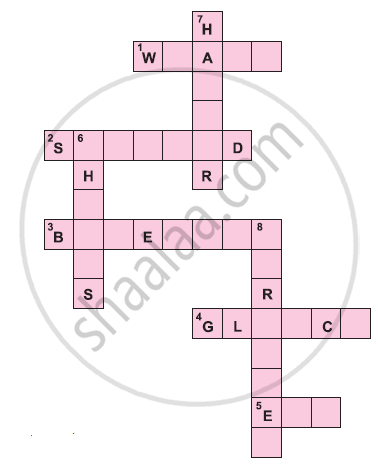
Across
1. very tired
2. had an angry look on the face
3. short trousers
4. a fault in a machine that prevents it from working properly
5. a small and naughty boy-fairy
Down
6. work that must be done every day, often boring
7. a basket with a lid
8. gave a short, high-pitched cry
What did Miss Beam teach the children at her school?
Multiple Choice Question:
What does the word ‘watch’ mean here?
What trick did the mongoose apply to overpower and kill the cobra?
Answer the following question:
An old man won a clock and sold it back to the shopkeeper. How much money did he make?
The words given against the sentences below can be used both as nouns and verbs. Use them appropriately to fill in the blanks.
(i) You deserve a ________________________ on the back for your good performance. (pat)
(ii) The teacher _________________________ the child on the cheek to encourage her.
What activities are dear to little children? Who does the child envy and why in the poem Vocation?
Read the following extract from Maya Angelou's poem, 'I Know Why the Caged Bird Sings' and answer the questions that follow:
|
But a caged bird stands on the grave of dreams |
- How does Angelou describe the state of the free bird in the opening lines of the poem? [3]
- Give a brief description of the caged bird's physical and mental condition. [3]
- Explain the phrase, 'grave of dreams' in your own words.
What does the caged bird sing about? [3] - The 'free bird' and the 'caged bird' in the poem represent different groups of people. Name them.
Name any one group of people that you would call 'caged birds' in today's world. [3] - What does the title of the poem, 'I Know Why the Caged Bird Sings', tell us about Maya Angelou's life?
Mention two ways in which the world of the caged bird differs from that of the free bird. [4]
