Advertisements
Advertisements
Question
State whether the following statements are true (T) or false (F). If false, correct them by changing any one single word in each.
Semi-circular canals are concerned with static (positional) balance.
Options
True
False
Advertisements
Solution
This statement is False.
Correct statement:
Semi-circular canals are concerned with dynamic (rotational) balance.
APPEARS IN
RELATED QUESTIONS
Answer the following:
Which part of the ear determines the pitch of a sound?
Perilymph or endolymph (Which one surrounds the organ of Corti?)
Which part of our ear is shaped like a snail shell?
Name the following:
The tube which connects the cavity of the middle ear with the throat.
Given below is a set of five parts. Rewrite them in correct sequence.
Cochlea, tympanum, auditory canal, ear ossicles, oval window.
With reference to the human ear, answer the question that follow:
Name the three small bones present in the middle ear. What is the biological term for them collectively ?
Name the part of the ear associated with hearing.
The figure below is the sectional view of a part of the skull showing a sense organ:
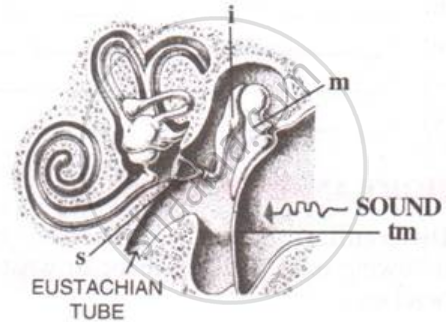
What do you call the part shown in the form of a spiral? What is its function?
______ is the smallest bone in the human body.
The spiral organ possessing sensory cells for hearing is ______.
